
November 27, 2024 • Norm
Day 13 — The Valley of the Kings, King Tut, and the Horse Cart That Took Us to the Wrong Market
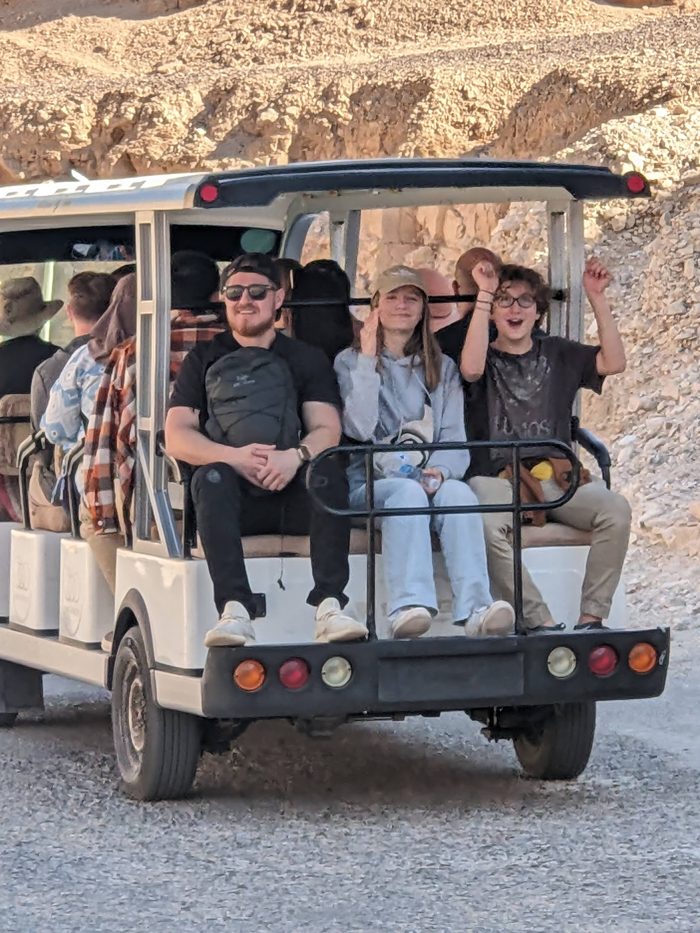
There are places in Egypt where the ancient world feels far away.
The Valley of the Kings is not one of them.
It feels close.
Not close in the comforting way, like an old family photo album. Close in the “we are walking into the hidden burial chambers of pharaohs” way. That is a slightly different emotional category.
We started early in the morning, because in Egypt, the two best reasons to start early are heat and crowds. Also, tour schedules enjoy making sure nobody gets too comfortable with sleep.
Our first stop was the Valley of the Kings, a rocky valley where ancient Egyptian rulers hid their tombs after pyramids proved to be a little too obvious for grave robbers.
This makes sense.
If you build a giant stone triangle in the desert, it does somewhat announce, “Important dead king and treasure located here.”
The Valley of the Kings was the quieter solution. Hide the tombs in the mountains. Decorate the walls. Seal everything up. Hope nobody finds it.
This worked with mixed results.
Walking Into the Tombs
With our admission tickets, we were able to visit three of the open tombs.
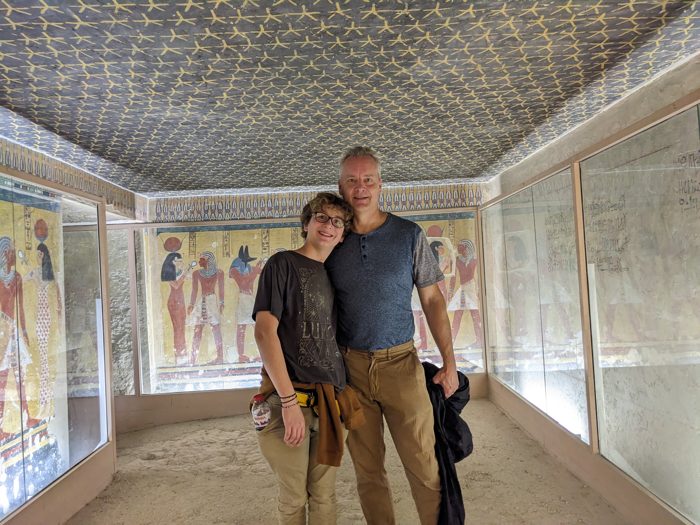
The tombs were not all equally impressive, but two of the three we chose were beautifully preserved. Their walls and ceilings were covered in carvings and painted designs, with colors that still somehow survived thousands of years underground.
That part amazed me.
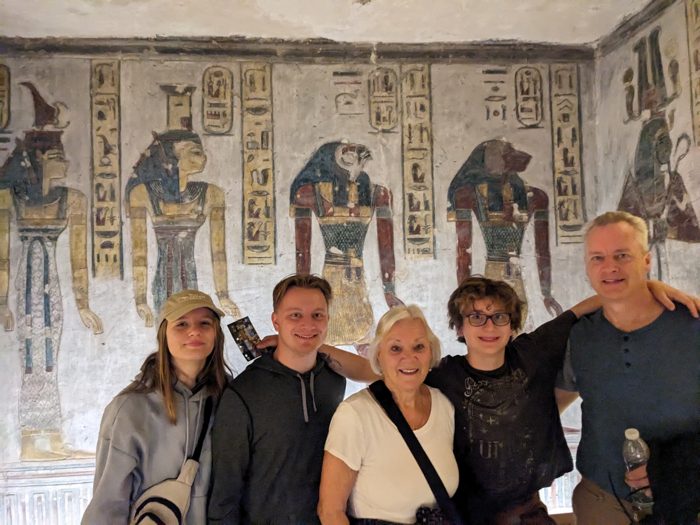
Paint in my house barely survives children.
Ancient Egyptian tomb paint survives millennia.
The passageways led downward into chambers covered with scenes, symbols, and stories designed for the afterlife. It was quiet in some places, crowded in others, and always slightly surreal.
You are not just looking at an artifact.
You are standing inside one.
There is something deeply humbling about that. These tombs were created with enormous belief, effort, skill, and resources. Every wall had purpose. Every symbol meant something. Every painted ceiling was part of a larger story of death, kingship, gods, and eternity.
Meanwhile, I was trying not to bump my head or lose track of the kids.
Travel keeps you grounded.
King Tut’s Tomb and the Price of Bragging Rights
We paid extra to enter King Tutankhamun’s tomb.
It was 700 EGP, about $14 USD, and I will be honest: the tomb itself was not as impressive as some of the others.
This is one of those travel truths that feels almost wrong to say out loud.
King Tut is famous because his tomb was discovered with so many treasures still inside, not because the tomb is the most spectacular one in the valley. Most of those treasures are now in museums, so what remains at the site is more about the significance than the visual impact.
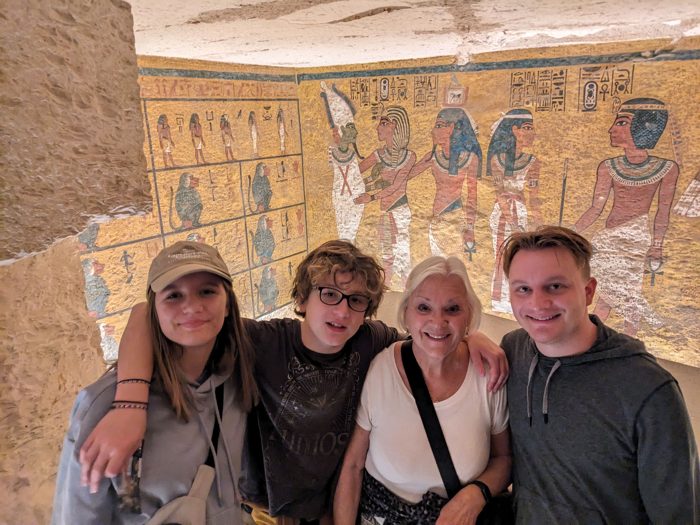
That said, it was the only tomb we visited that still had something inside.
King Tut’s mummified body was there.
So yes, we paid for the bragging rights.
And sometimes in travel, bragging rights are not nothing.
Was it worth the extra cost? Maybe. If you are deeply interested in Egyptian history or want to say you stood inside King Tut’s tomb, then yes. If you only care about the most beautiful tomb paintings, some of the included tombs may actually be more rewarding.
This is one of those moments where the practical traveler and the emotional traveler argue.
The practical traveler says, “That was overpriced.”
The emotional traveler says, “But it was King Tut.”
The emotional traveler usually wins.
Afternoon Freedom and a Very Helpful Young Driver
By afternoon, we had free time to explore on our own.
We started walking down the main street in front of our hotel, looking for the marketplace. It seemed simple enough.
This should have been our first warning.
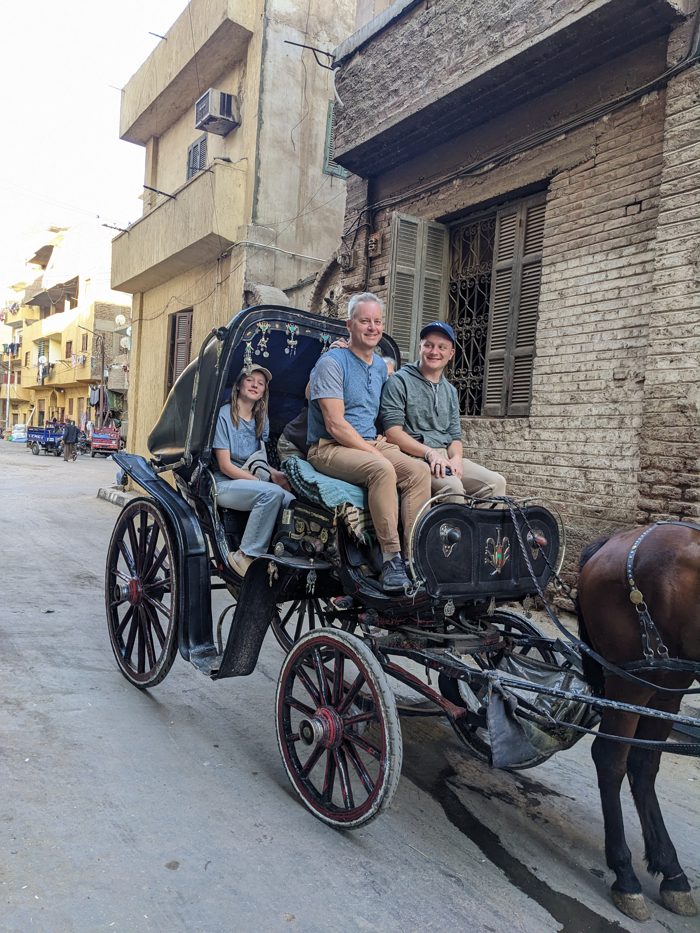
A young boy in a horse-drawn carriage began following us, offering to take us to the market.
This happens often in Egypt. Someone appears beside you with transportation, information, a shop recommendation, or all three. He was persistent and told us he could take all five of us to the “Egyptian Market” for only 50 Egyptian pounds.
That is about 50 cents.
For all five of us.
At that price, walking began to feel financially irresponsible.
So we climbed in.
The carriage pulled into traffic, surrounded by honking horns, busy streets, and the general Egyptian road experience, which often feels like a live demonstration of confidence over lane markings.
We thought we were being taken to the outdoor market.
We were not.
We were dropped in front of a shop with a sign that said “Egyptian Market.”
Technically, he had told the truth.
Emotionally, we had been bamboozled.
The Egyptian Market That Was Definitely a Shop
Inside were many of the same tourist souvenirs we had seen over the past several days.
Our young driver explained that this was better than the tourist market. Egyptian prices. Better deals. We did not want the other market.
This, of course, was because he likely received a commission if we bought something there.
I could not even be mad.
The system was too clear.
He had offered us a cheap ride, delivered us to a shop, and hoped we would buy enough souvenirs to make the arrangement worthwhile. It was a tiny horse-drawn business model on wheels.
We looked around politely, then made it clear we wanted the actual outdoor market.
He seemed disappointed.
I admired his effort.
But we were not staying.
The Real Market and the Rise of the Young Negotiators
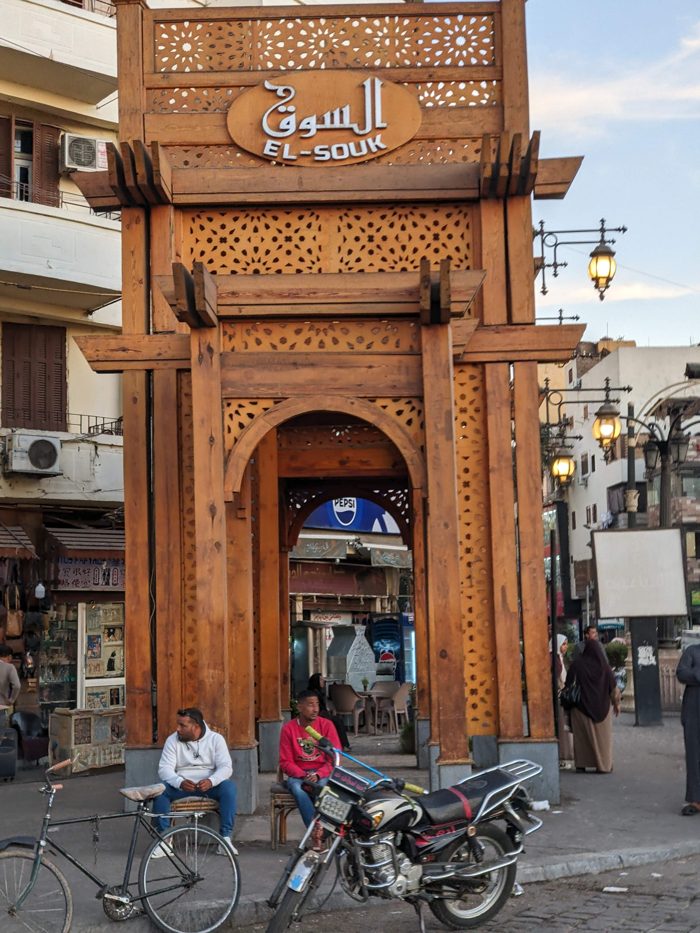
Eventually, we made it to the tourist market we had been looking for all along.
And once again, the kids came alive.
Zakary, Teyauna, and Orin were fully into haggling by this point in the trip. They had learned the rhythm: ask the price, react dramatically, offer less, walk away if needed, and watch the price suddenly become more flexible.
It was fun watching them bargain for souvenirs and spices.
They were not rude. They were engaged. They were learning how markets work in a place where prices are often a conversation rather than a label.
They bought gifts, spices, and more treasures to fit into suitcases that were already beginning to threaten rebellion.
I started to wonder whether we should have budgeted not only for souvenirs, but for luggage expansion therapy.
The market was full of color, sound, and movement. Shops were packed with goods. Vendors called out. The smell of spices mixed with dust and street food. Every few steps someone wanted to show us something.
It was a lot.
But by now, we had adjusted.
Markets that might have overwhelmed us at the start of the trip had become part of the fun. The kids were confident. I was still mediocre at bargaining, but I had accepted that about myself.
Growth comes in many forms.
Sometimes it is spiritual.
Sometimes it is realizing your children are better negotiators than you.
Tombs in the Morning, Trinkets in the Afternoon
That is one of the strange things about Egypt.
In the morning, you stand inside ancient royal tombs built for eternity.
In the afternoon, you are negotiating over souvenirs and spices with children who have discovered the power of walking away.
Both feel very Egyptian in their own way.
The country does not separate ancient wonder from everyday hustle. You move from carved tomb walls to honking traffic, from pharaohs to horse carts, from sacred burial chambers to someone insisting he can give you a “good price.”
It can be overwhelming, but it is also what makes travel here so memorable.
Egypt is not quiet about being Egypt.
It gives you history at full volume, then surrounds it with modern life moving just as loudly.
By evening, we were tired, carrying more bags than we had intended, and still laughing about our ride to the “Egyptian Market” that was technically a market only because the sign said so.
In the next installment, we wake up even earlier for a sunrise hot air balloon over Luxor, join a sky full of balloons, visit the massive Karnak Temple, and end the day watching Luxor Temple from a rooftop restaurant.