
May 19, 2026 • Norm
Day 31 — Danube Gorges, Border Confusion, Fortress Dinosaurs, and Dessert Before and After Dinner
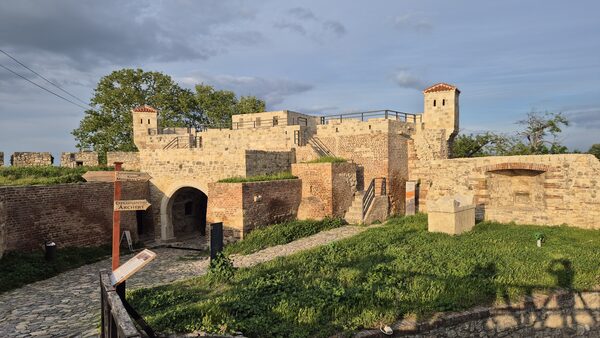
Tuesday, May 19, 2026
Route: Belogradchik, Bulgaria → Calafat, Romania → Iron Gates / Danube Gorge → Belgrade, Serbia
This was mostly a driving day.
That is the phrase travelers use when they want a day to sound simple.
It was not simple. It was a long chain of roads, borders, river gorges, passport disappointment, fortress wandering, medieval sword practice, crepes, dinner, and ice cream. So yes, technically a driving day. But the kind of driving day that collects stories until it stops being transportation and becomes an episode.
We left Belogradchik early, partly because we had a long drive ahead and partly because our accommodation had already given us all the authenticity we needed. It had beds, old fuses, dated furniture, and a level of character strong enough to encourage departure.
Daniel looked around one last time.
“We should leave early.”
“I agree,” I said. “Before the building changes its mind and keeps us.”
Across the Danube Into Romania
We crossed into Romania at Calafat, over the Danube. At first, Romania did not exactly throw rose petals at our arrival. The area felt industrial and not particularly scenic. I remember thinking that if I drove this route again, I would probably cross farther west near the Iron Gates instead.
But eventually the day found its scenery.
The Iron Gates and Decebalus
The Iron Gates are one of the dramatic gorge sections of the Danube, where the river cuts between mountains and cliffs. Once we reached that area, the drive changed completely. The Danube narrowed, the road twisted, forested slopes rose steeply from the water, and the whole landscape became powerful and cinematic.
“This is much better,” I said.
Daniel steered through another curve.
“Yes. Also much windier.”
Both things were true.
Our first memorable stop was the huge rock carving of Decebalus, the last king of Dacia, staring out over the Danube from the cliff. It is enormous — the kind of monument that makes you wonder who first looked at a mountain wall and said, “You know what this needs? A face.”
A few minutes later, we stopped at Mraconia Monastery, perched beautifully on the edge of the Danube. The setting was spectacular: water, cliffs, mountains, monastery walls. I wanted to see the view from the riverfront side, but access was limited.
“The monks must have the best view,” I said.
“And they are not sharing properly,” Daniel replied.
Still, it was a worthwhile stop.
A Border With No Stamp
Then we continued toward Serbia. At the Serbian border, we left the European Union, and the crossing became more memorable than expected. The guard appeared to be in training, which is not a criticism. Everyone has to learn somewhere. I just happened to be the Canadian passport he was learning on.
There were no other cars waiting, so 15 minutes was not a problem. But there was a lot of screen-checking, consultation, photo-taking, retaking, and eventually fingerprints.
Daniel watched from nearby.
“Maybe you blinked.”
“I think Canada is confusing them.”
Finally, everything was approved. But there was no passport stamp.
This was deeply disappointing. After photos, fingerprints, and official confusion, I wanted ink. Instead, they told me it was electronic now.
Very efficient.
Emotionally unsatisfying.
We reached Belgrade in the late afternoon, gaining an hour with the time change, which made us feel like competent planners even though geography had done most of the work.
Fortress Dinosaurs in Belgrade
After checking in, we walked from Republic Square along Knez Mihailova Street toward Kalemegdan Fortress. Belgrade felt energetic, layered, and lived-in. It was not polished in the soft tourist way, but it had life everywhere: people walking, eating, talking, shopping, meeting friends, and filling the pedestrian streets.
Kalemegdan Fortress was one of the highlights. It sits where the Sava River meets the Danube, which explains why people spent centuries fighting over it. Today, though, it is also a public park, and that creates a wonderfully strange mix.
Daniel noticed it first.
“You have a playground over there, dinosaurs over there, and tanks over there.”
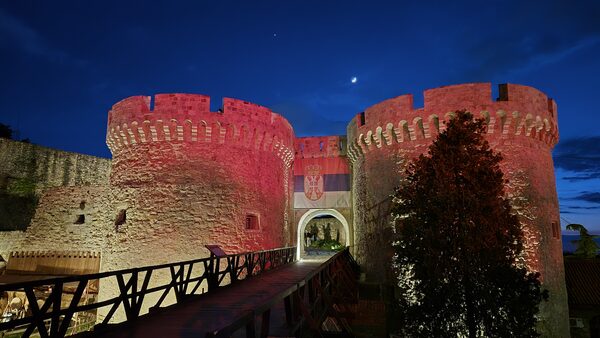
He was right.
Families, dinosaur park, old fortress walls, souvenir stands, cannons, tanks, and military displays all seemed to coexist peacefully. It was like someone planned the park by asking, “What do people like?”
Children. Dinosaurs. History. Artillery. Snacks.
And somehow, it worked.
At the fortress, we also saw a medieval skills group practicing archery and sword fighting. In a few minutes, we had gone from dinosaur park to war museum to people casually swinging swords.
“This place has range,” I said.
“Dinosaurs to swords in five minutes,” Daniel replied.
Before dinner, we had crepes. I would like to say this was intentional culinary planning, but really we saw crepes and had limited resistance.
Then we went to Skadarlija, Belgrade’s Bohemian Quarter, for dinner. The atmosphere was the highlight: cobbled street, music, restaurants, evening lights, and the sense that Belgrade gets more interesting after dark.
After dinner, we returned to the fortress to see it lit up at night. The rivers were dark below, the city lights spread out around us, and the fortress walls took on a different mood.
Then, naturally, ice cream.
This meant the day included pre-dinner dessert and post-dinner dessert.
Daniel looked at me.
“Is that necessary?”
“No,” I said. “That is what makes it dessert.”
A mostly driving day, apparently.
But a very good one.