
November 28, 2024 • Norm
Day 14 — Sixty Balloons, One Sunrise, and the Karnak Temple That Would Not Stop Being Huge
There are mornings when waking up at 4:30 a.m. feels like punishment.
This morning felt like punishment with potential.
We were in Luxor, and we had booked a sunrise hot air balloon ride. After seeing photos from others in our Morocco group who had taken an early balloon ride over Marrakech, we decided to try the sunrise version in Egypt.
The price helped.
Hot air balloon rides in Egypt were roughly 30% of what they cost in Morocco, which made the decision feel less like an extravagance and more like responsible financial planning with fire and wicker baskets.
The previous day’s balloon rides had been cancelled because of wind, so demand was higher than normal. The night before, the travel agent called and said they needed an additional $20 from me.
I refused.
Then they asked if they could refund me and have me pay directly to the balloon operator instead.
It was a strange little negotiation, but we managed to salvage the ride.
At this point in the trip, “strange little negotiation” had become a recurring theme.
The Field of Sleeping Giants
We arrived at the launch site around 5:15 a.m.
It was cold.
About 12°C cold.
That may not sound dramatic to Canadians, but standing in a dark field before sunrise waiting for a hot air balloon makes 12°C feel personal.
Spread across the field were at least 60 hot air balloons lying flat on the ground.
Sixty.
It looked like a giant had dropped colorful laundry across the Egyptian countryside.
For a while, nothing happened. We stood around in the cold, moving just enough to keep warm, waiting for permission to launch.
Then everything came alive at once.
Generators started. Huge fans roared. Balloons began to swell and rise. Burners fired, lighting the fabric from inside with bursts of orange flame.
The field transformed from darkness into glowing color.
It was spectacular.
There are moments when travel makes you feel like a child again, and watching dozens of hot air balloons inflate before sunrise is one of them. Everyone looked up. Everyone took photos. Everyone forgot, briefly, that they were cold and underslept.
Floating Over Luxor
We climbed into the basket with about 12 people, and soon we lifted off.
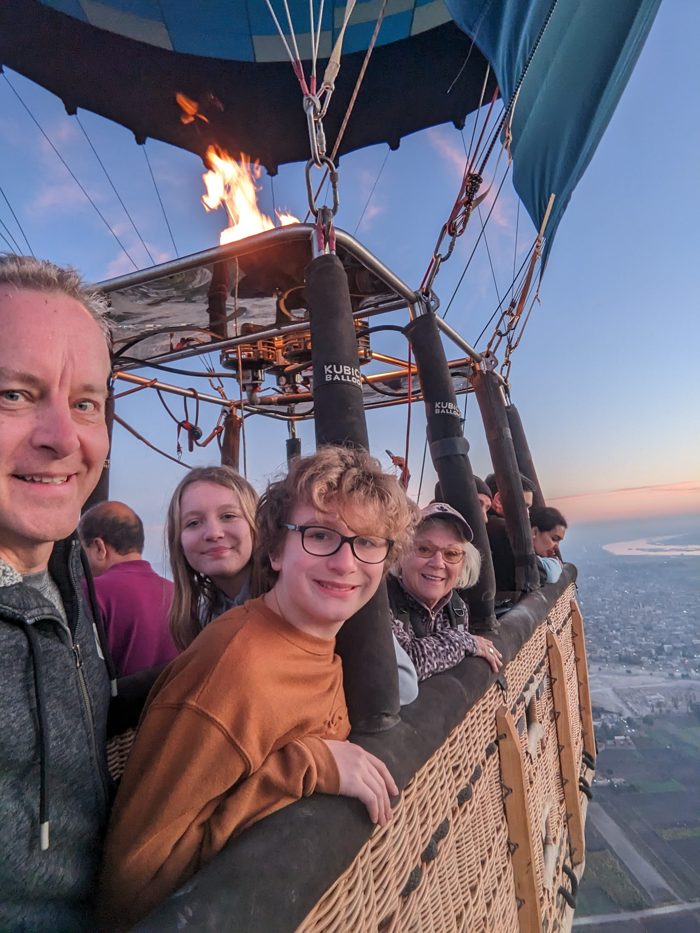
The ground dropped away gently, and the balloons around us began rising too. One after another, they floated into the early morning sky, glowing against the pre-sunrise horizon.
The view was incredible.
Below us were farm fields, villages, archaeological sites, and the landscape around the Valley of the Kings. Ahead, the sun slowly approached the horizon.
For about an hour, we floated over Luxor.
That is longer than our balloon ride in Morocco, and the sunrise made it feel even more special. Halfway through the flight, the sun finally rose, lighting the fields and temples below.
It was one of the most beautiful moments of the trip.
The kind that makes you forget the early alarm, the cold field, the booking confusion, and the part of your brain that had questioned whether this was a good idea.
It was absolutely a good idea.
Sometimes the difference between regret and wonder is just getting out of bed when the alarm rings.
Landing in a Farmer’s Field
Eventually, we descended and landed in a farmer’s field.
This felt very Egypt.
One minute you are floating above ancient sites in a sunrise sky.
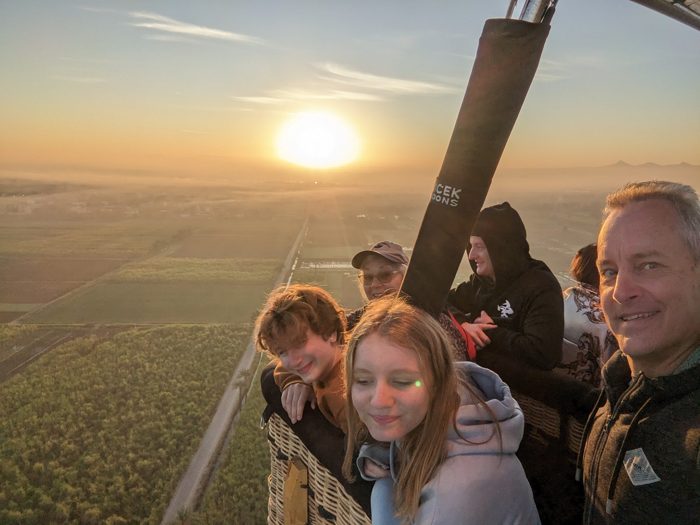
The next, you are standing in a field waiting for someone to collect you.
We were picked up and driven back to the river, then shuttled across to our hotel. By the time we returned, our tour group had already left for Karnak Temple.
So we ate quickly and took a taxi to catch up.
This is another family travel skill: rejoining the itinerary while slightly behind schedule, slightly underfed, and still emotionally floating.
Karnak Was Not a Temple. It Was a Stone City.
When we arrived at Karnak Temple, we were immediately struck by its size.
Massive does not really cover it.
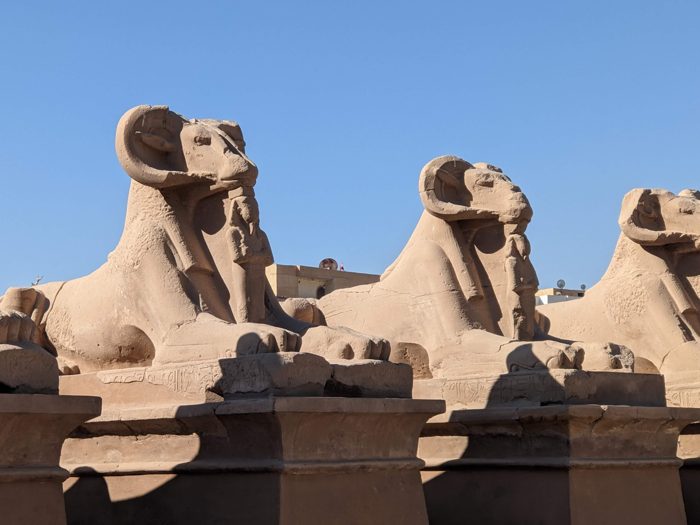
Karnak felt less like a single temple and more like an entire ancient city of stone. Columns, obelisks, walls, courtyards, carvings — it went on and on. Every time I thought we had seen the main part, there was another section.
The columns were enormous.
Truly enormous.
Standing among them made us feel tiny, which was probably part of the point. Ancient Egyptians were very good at architecture that reminded everyone exactly where humans stood in relation to gods, kings, and giant stone.
The carvings covered walls and columns in incredible detail. Some were worn by time, others still sharp enough to imagine the hands that made them. The scale of effort was hard to comprehend.
We had about two hours to wander, and even that felt short.
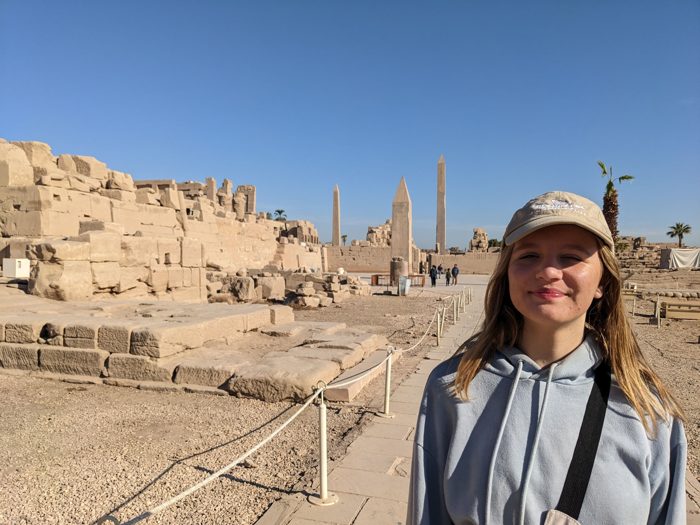
Karnak is one of those sites where you could spend half a day and still miss things. It is an essential stop in Egypt, and I was glad we had caught up with the group.
Even if we arrived slightly late and probably still smelled faintly of balloon basket.
Funtasia and a Different Side of Egypt
After Karnak, we took a boat ride to the West Bank of the Nile and were shuttled to a community organization called Funtasia.
Funtasia provides after-school activities for children, mostly through art and agriculture. It was a very different kind of stop after so much ancient history.
They had bikes for us to explore the local neighborhood on a short guided ride.
The ride lasted only about 15 minutes, but it gave us a glimpse of a quieter village side of Egypt. Narrow streets, local homes, children, daily life — not the Egypt of temples and tombs, but the Egypt where people live.
I appreciated that.
It is easy for a trip through Egypt to become entirely ancient. Pharaohs, tombs, mummies, temples, statues, repeat. All impressive, yes, but modern Egypt is not just the backdrop to its past.
Stops like Funtasia help balance that.
They remind you that history may bring travelers here, but people live here now.
Rooftop Dinner and One Last Market Mission
We returned to the hotel around 1 p.m. for a short rest, which was very welcome after the 4:30 a.m. start.
Later, we went to a nearby rooftop restaurant overlooking Luxor Temple.
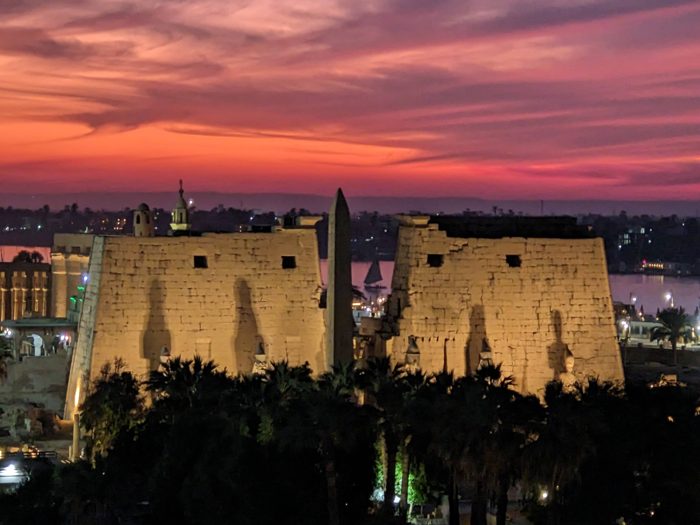
The food was good and affordable, but the view was the real prize. From above, we could see the temple complex across the street and watch the life of the city square below.
Kids wandered.
People gathered.
Traffic moved.
The ancient stones glowed as the light changed.
It was one of those perfect travel pauses where you are still sightseeing, but sitting down with food while doing it. This is my preferred level of efficiency.
The rest of the evening was free, and naturally the kids wanted more time in the market.
They had Egyptian money left and were determined not to waste it. We were leaving the next morning, and aside from the tip set aside for our tour leader, we did not need much cash anymore.
So back to the market we went.
They bought rings, Egyptian shopping bags, sweets, and final gifts to bring home.
Their bargaining confidence was now fully developed. I watched with the pride of a father whose children may one day negotiate a better hotel rate than he can.
A Full Day, From Sky to Street
This was one of those travel days that felt like three days in one.
We began in a dark field surrounded by sleeping balloons.
We floated over Luxor at sunrise.
We stood beneath the massive columns of Karnak.
We rode bikes through a local village.
We ate dinner overlooking Luxor Temple.
We ended in the market, spending the last of the Egyptian cash.
It was exhausting, but in the best way.
Egypt had given us many grand moments already, but the sunrise balloon over Luxor stood apart. Maybe because of the light. Maybe because of the number of balloons. Maybe because seeing temples, fields, and villages from above gave us a different sense of the place.
Or maybe because any experience that begins with 60 balloons glowing in the dark is almost guaranteed to stay with you.
In the next installment, we fly from Luxor to Cairo, say goodbye to our Egypt tour group, and discover that Cairo Airport may be one of the most confusing places on earth to make a connection.