
November 25, 2024 • Norm
Day 11 — Abu Simbel Was Worth the 3:45 A.M. Wakeup, But the Driver’s Phone Was Not
There are wakeup times that feel adventurous.
There are wakeup times that feel unpleasant.
And then there is 3:45 a.m., which feels less like morning and more like a clerical error.
Our alarms went off in Aswan while the world outside was still completely dark. By 4:00 a.m., we were in front of the hotel waiting for our tour pickup to Abu Simbel.
Abu Simbel is one of my favorite archaeological sites in Egypt, and I knew it would be worth the early start.
Knowing something is worth it, however, does not make your body agree at 3:45 a.m.
My body was filing a complaint.
The Long Drive South
It took about an hour to pick up two other travelers and reach the checkpoint for the road to Abu Simbel.
From there, the drive was long and mostly uneventful.
Mostly.
At one point, I had to ask our driver not to text and watch videos on his phone while driving.
This is one of those sentences you hope never becomes part of your travel story.
I understand long drives can be boring. I understand phones are tempting. But when you are being driven through the Egyptian desert before sunrise, you develop a strong preference for the person behind the wheel focusing on the road rather than entertainment options.
Thankfully, he listened.
We continued onward with one bathroom stop along the way, the kind of stop that feels both necessary and slightly surreal when you are half-awake in the desert.
By around 8 a.m., we arrived at Abu Simbel.
And just like that, the horrible wakeup time made sense.
Ramses II Knew How to Make an Entrance
Abu Simbel does not gently introduce itself.
It announces itself.
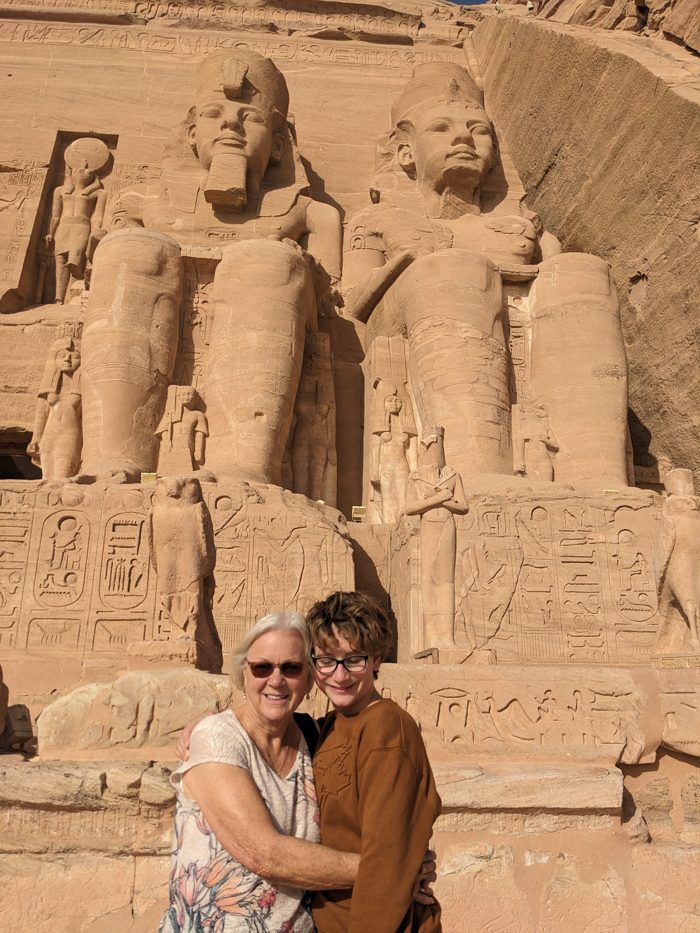
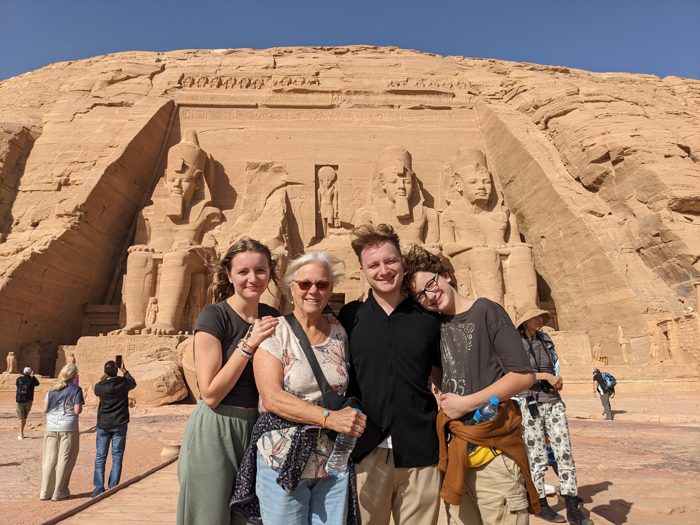
Four enormous statues of Ramses II sit at the entrance to the Great Temple, carved into the rock face and staring out with the confidence of a king who clearly had no interest in subtle architecture.
They are massive.
Not “large statue” massive.
More like “this person wanted everyone approaching by land, river, or imagination to understand exactly who was in charge” massive.
Standing in front of them is humbling. The scale, symmetry, and setting all work together. The temple feels remote and powerful, as though it belongs exactly where it is, even though, astonishingly, it does not.
Because Abu Simbel was moved.
That is one of the most remarkable parts of its story. When the High Dam was built and Lake Nasser began to rise, Abu Simbel was at risk of being submerged. So engineers and archaeologists cut the temples into pieces and relocated them to higher ground.
The idea still amazes me.
It is hard enough to move furniture without damaging a wall.
They moved a mountain temple.
Inside the Temples
We had about an hour and a half to explore the two main temples before meeting with our guide for more explanation.
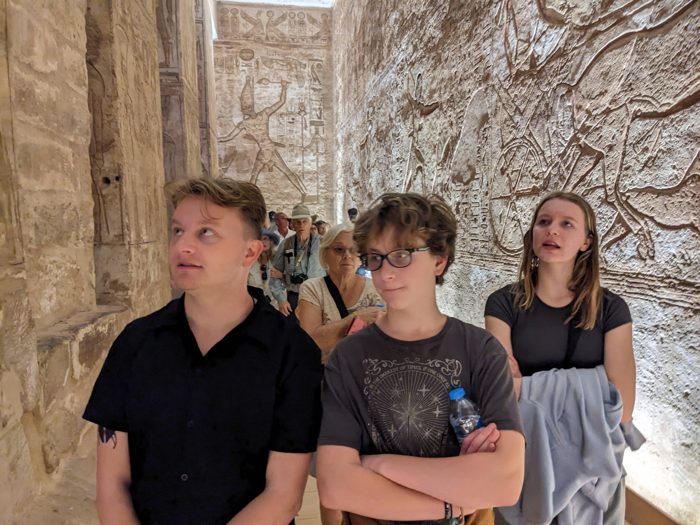
Inside, the carvings and chambers pulled us into another world. The walls told stories of power, gods, battles, devotion, and the ancient Egyptian talent for making stone feel alive with meaning.
The Great Temple of Ramses II was the showstopper, but the smaller temple dedicated to Queen Nefertari was also beautiful. Abu Simbel has a way of making you slow down and look carefully, even when tour groups are moving around you.
There is so much to take in: the figures, the hieroglyphs, the alignment, the engineering, the survival story.
And the location.
Even though it was moved, the site still feels dramatic. The lake, the desert, the temple fronts — everything comes together in a way that feels almost cinematic.
But unlike a movie set, this was real.
Ancient ambition. Modern preservation. Human effort across thousands of years.
And us, slightly sleep-deprived, walking through it all.
The Exit Through Tourist Temptation
Leaving Abu Simbel took longer than expected because, as with many major sites, there were vendors ready to sell souvenirs, trinkets, scarves, carvings, and all the small objects that whisper, “You have room in your suitcase.”
We did not really have room in our suitcase.
Our luggage had already been introduced to Moroccan markets and Egyptian bargaining. It was beginning to resemble an archaeological dig of its own.
Still, the vendors were persistent, and we slowly made our way through the selling gauntlet back to the car.
This is part of the rhythm of travel in Egypt. The ancient sites are astonishing, and the exits often require polite determination. You learn to smile, say no, keep walking, and occasionally admire something long enough that the price discussion begins without your consent.
Eventually, we escaped.
Victorious.
Mostly souvenir-free.
The Return to Aswan and the Familiar Golden Arches
The drive back to Aswan included another tourist bathroom stop and a lot of tired silence.
We reached the hotel around 2 p.m., exhausted from the early morning and long drive.
A sensible person might have rested.
We walked five minutes along the waterfront to McDonald’s.
I know.
You do not travel all the way to Egypt to eat McDonald’s.
But after more than a week of travel, early mornings, rich meals, long drives, and constant movement, familiar food can become strangely comforting. Sometimes you do not need a culinary adventure. Sometimes you need fries that taste exactly the way your tired brain expects them to taste.
It was the first familiar meal we had eaten in over a week.
No regrets.
One More Market Visit
In the evening, we returned to the market across from the hotel.
The kids wanted to buy a few more souvenirs and gifts for friends. There were spices for their mother, small items for people back home, and more chances to bargain.
By now, they had become more confident negotiators.
This was fun to watch.
At the beginning of the trip, bargaining felt unfamiliar. Now they understood the rhythm. Ask. Counter. Laugh. Walk away if needed. Watch the price change. Decide what something is worth to you.
It is a practical travel skill, but also a confidence builder.
The market was lively again, with vendors calling out and colors stacked everywhere. Spices, carvings, jewelry, fabric, souvenirs — Aswan’s evening energy had pulled us back for one more round.
By the time we returned to the hotel, the day felt impossibly long.
Because it had been.
We had started before 4 a.m., crossed the desert to one of Egypt’s greatest archaeological sites, walked beneath the gaze of Ramses II, survived a driver’s questionable phone habits, returned to Aswan, eaten McDonald’s, and shopped for spices.
Not bad for a day that began when most sensible people were asleep.
Abu Simbel was absolutely worth it.
But I still believe 3:45 a.m. should be treated with caution.
In the next installment, we slow down on a felucca sail along the Nile, meet a singing boy on a paddleboard, visit Kom Ombo’s crocodile mummies, and arrive in Luxor just as the sun begins to set.