
November 24, 2024 • Norm
Day 10 — Aswan Welcomed Us With Island Temples, Market Haggling, and a Man Who Remembered My Name
There is something disorienting about waking up on a sleeper train and realizing the day has already started without asking your permission.
We were on our way to Aswan after a long Cairo day and an overnight train ride that had been memorable mostly because it had character.
Character, in travel, often means something was old, confusing, uncomfortable, or all three, but somehow still worked.
Our train arrived in Aswan just before 9:30 a.m., which was apparently unusually early. The locals seemed to suggest the train was normally late, so we had accidentally experienced Egyptian rail efficiency.
I did not question it.
When travel gives you an early arrival, you accept the gift quietly and avoid making eye contact with fate.
Aswan Felt Softer Than Cairo
After Cairo’s noise, traffic, crowds, and pyramids, Aswan felt calmer almost immediately.
Our bus picked us up and took us to the hotel. Others in our group continued on to Philae Temple right away, but I had booked a private tour for our family later that day.
This turned out to be a good decision.
Traveling with kids is wonderful, but sometimes they need history in manageable portions. Not every temple requires a university lecture. Sometimes a child needs the shorter version, preferably with shade and a clear answer to “How much longer?”
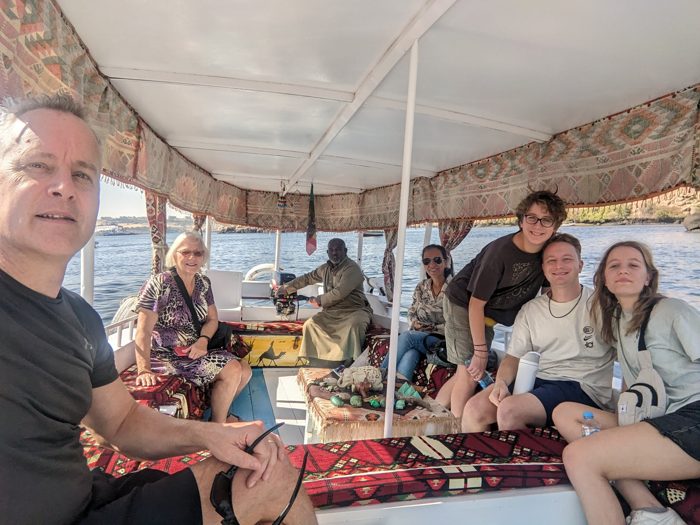
With a private guide, we could move at our own pace.
That phrase may be one of the most beautiful in family travel.
The Temple That Moved Islands
Around midday, our private tour picked us up for Philae Temple.
To reach the temple, we bought our entrance tickets and then hired our own boat driver to take us across the water to the island. The boat ride itself made the visit feel special. Temples are impressive on land, but arriving by boat gives everything a little extra drama.
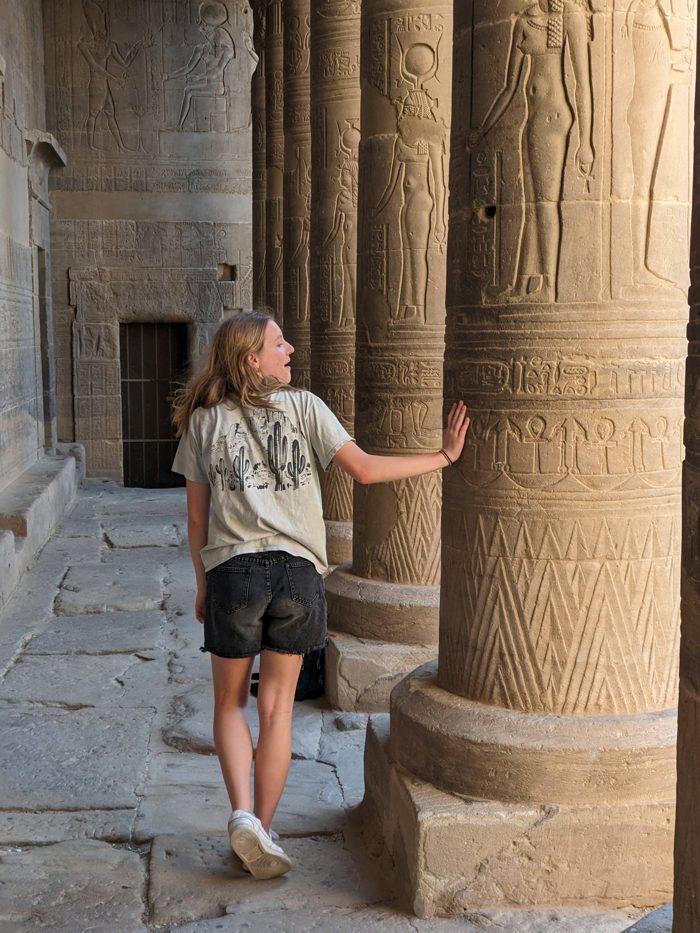
Philae Temple had been moved after the Nile was flooded by the construction of the High Dam. That fact alone is remarkable. An entire temple complex relocated to save it from disappearing underwater.
I sometimes struggle to move a suitcase from the hotel room to the lobby without leaving something behind.
The idea of moving ancient stone temples is on another level entirely.
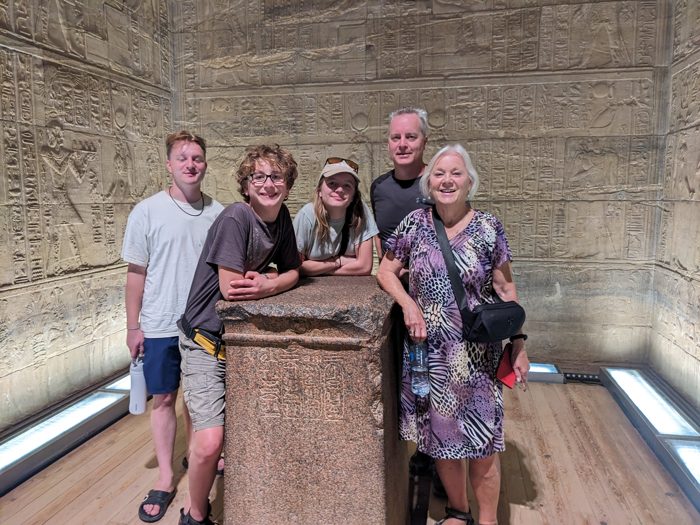
The site had layers of history. Greek influence. Ancient Egyptian carvings. Later Coptic Christian markings etched over older designs. Many of the figures of Greek gods had been scraped from the walls, leaving outlines like ghosts of older beliefs.
This is one of the things I find fascinating about places like Egypt. Civilizations did not simply vanish and get replaced in tidy chapters. They overlapped. Reused. Changed. Scratched things out. Added their own meanings.
The walls became a conversation across centuries.
The kids were able to explore without being rushed, and having our own guide made the visit feel much more personal. We could pause when something was interesting and move on when attention spans began to flicker.
Every parent knows the look.
The eyes glaze slightly.
The feet begin shifting.
Someone asks about snacks.
That is when you know the gods of ancient Egypt have temporarily lost the battle.
The High Dam and the Scale of Modern Egypt
After Philae, we continued to the High Dam.
Built from 1960 to 1971, the dam was designed to control the seasonal flooding of the Nile and produce power for Egypt. It is massive, and standing there you get a sense of how much the Nile has shaped the country, not just in ancient times but in modern life too.
The Nile is not just a river here.
It is the spine of the country.
Ancient temples, farming, transportation, cities, and modern infrastructure all seem to orbit around it. Seeing the dam after visiting a temple that had to be moved because of the rising water helped connect two very different eras of Egyptian history.
Ancient stone.
Modern concrete.
Both trying, in their own way, to manage life beside the river.
The “Free Massage” That Came With a Sales Pitch
On the way back to the hotel, we stopped at a store selling essential oils.
There was the promise of a “free massage.”
By this point in our travels, I had learned that the word “free” sometimes arrives wearing quotation marks.
We smelled oils. We listened to explanations. We saw glass-blowing ornaments. Zak particularly loved the glass blowing, especially when the technician popped a large hot glass bubble.
That part was genuinely fun.
Of course, the hope was that we would buy oils and glass ornaments, which we did. The stop took longer than expected, but in the end we had a good time. Sometimes these shopping stops can feel drawn out, but every once in a while a detail sticks — like a child watching hot glass inflate and burst with complete fascination.
Travel is unpredictable that way.
You think the temple will be the only memorable part, and then someone pops molten glass and steals the show for five minutes.
The Market Took Over the Evening
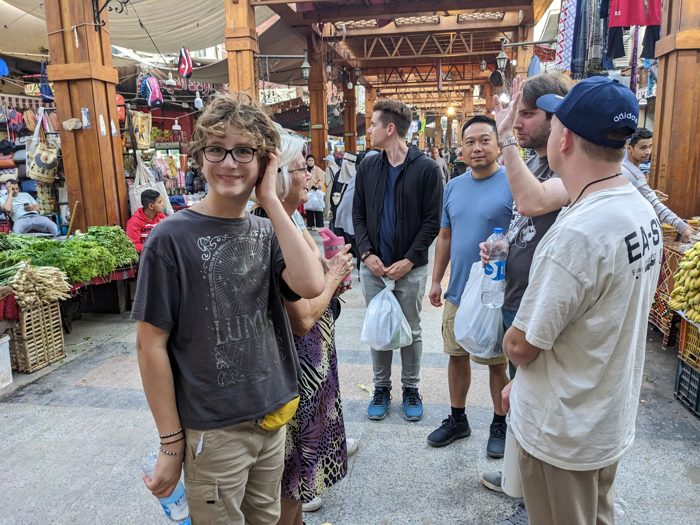
We missed our group tour to the marketplace, so our family simply walked across the street from the hotel to the main market ourselves.
At first, we planned to spend only a few minutes.
This is how markets win.
As dusk settled, the market became livelier. Vendors sat on both sides, calling us over to look at spices, jewelry, souvenirs, carvings, clothing, and all the things travelers suddenly believe they might need.
The kids got into the spirit of bargaining.
Teyauna bought two small pyramids. Zak picked out a stone-carved turtle. Orin found a necklace and a baseball cap.
Haggling became part shopping, part performance, and part math lesson. The kids learned quickly that walking away could cause prices to drop with magical speed.
This is a useful life skill.
Possibly more practical than algebra.
We stayed far longer than planned, moving from stall to stall, negotiating, laughing, and slowly adding more small objects to our already threatened luggage capacity.
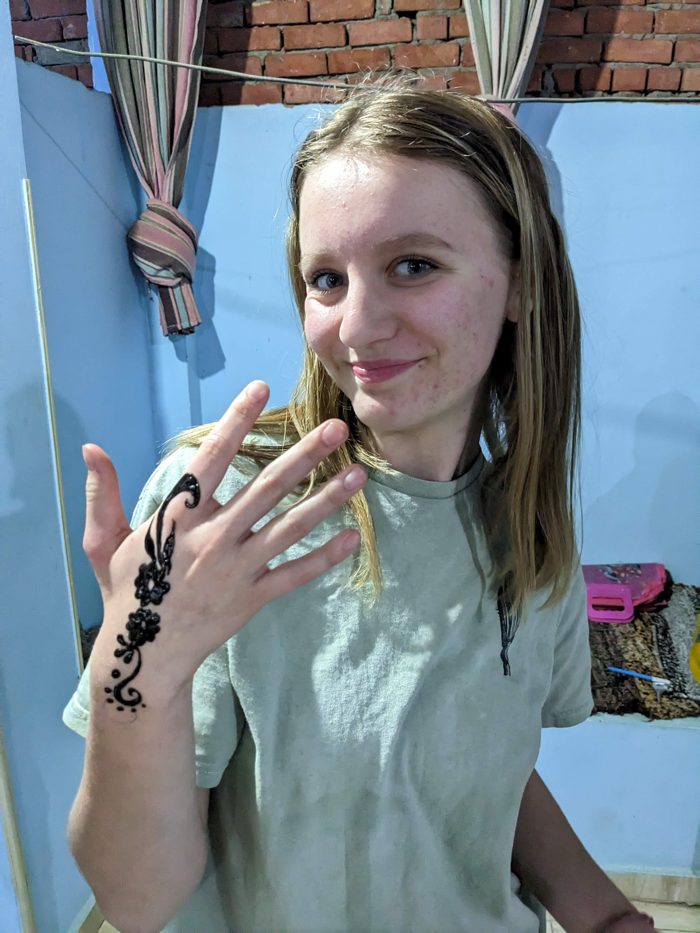
I was proud of the kids. They were polite, engaged, and clearly enjoying the challenge. Markets can overwhelm people, but they leaned into it.
Also, they liked buying things.
That probably helped.
Dinner With Mohammed
Our final activity of the day was a dinner in a Nubian village near the hotel.
Our host, Mohammed, greeted me warmly and said, “Normand, do you remember me?”
I paused.
Eight years earlier, I had been on the same tour, and Mohammed remembered my name.
That kind of thing stays with you.
Travel can sometimes feel temporary. You move through places quickly, meeting people briefly, taking photos, and continuing onward. But then someone remembers you years later, and suddenly a past trip connects with the present one in a very human way.
Mohammed took us by boat up the river about five minutes to the entrance of his village along the Nile. We went to his family’s third-floor rooftop dining room overlooking the river.
The setting was beautiful.
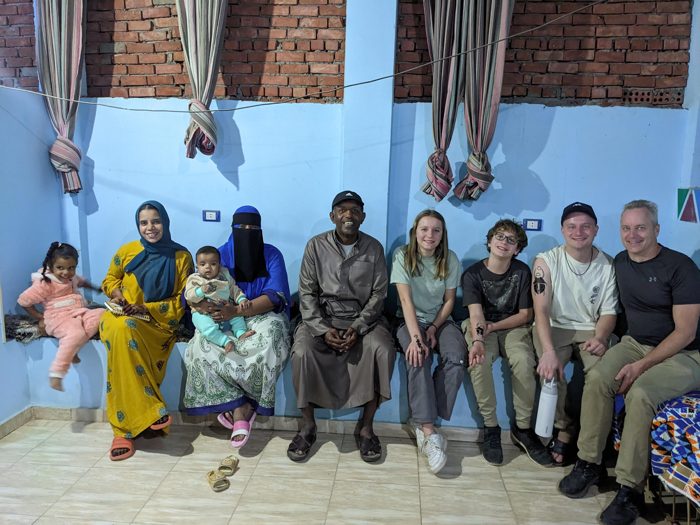
The meal was warm and generous.
The chicken was incredible.
After a full day of temples, dams, sales pitches, markets, and bargaining, sitting on a rooftop with a local family felt like the right ending. Slower. More personal. More connected.
We returned to the hotel around 9 p.m., which would normally be a respectable time to relax.
Except we had a 3:45 a.m. wakeup call scheduled for Abu Simbel.
This is the part of travel where you stop asking whether the schedule is reasonable and simply start setting alarms.
Aswan had given us a softer day than Cairo, but not an empty one. We had moved from ancient island temples to modern dams, from market chaos to rooftop hospitality, from glass bubbles to memories from eight years earlier.
And now, because apparently sleep was optional, we were preparing to wake before dawn for one of Egypt’s most spectacular sites.
In the next installment, we leave at 4 a.m. for Abu Simbel, one of my favorite archaeological sites in Egypt, and I have to ask our driver not to watch videos while driving through the desert.