
May 8, 2024 • Norm
The Day I Went to Kiribati Without Actually Going to Kiribati
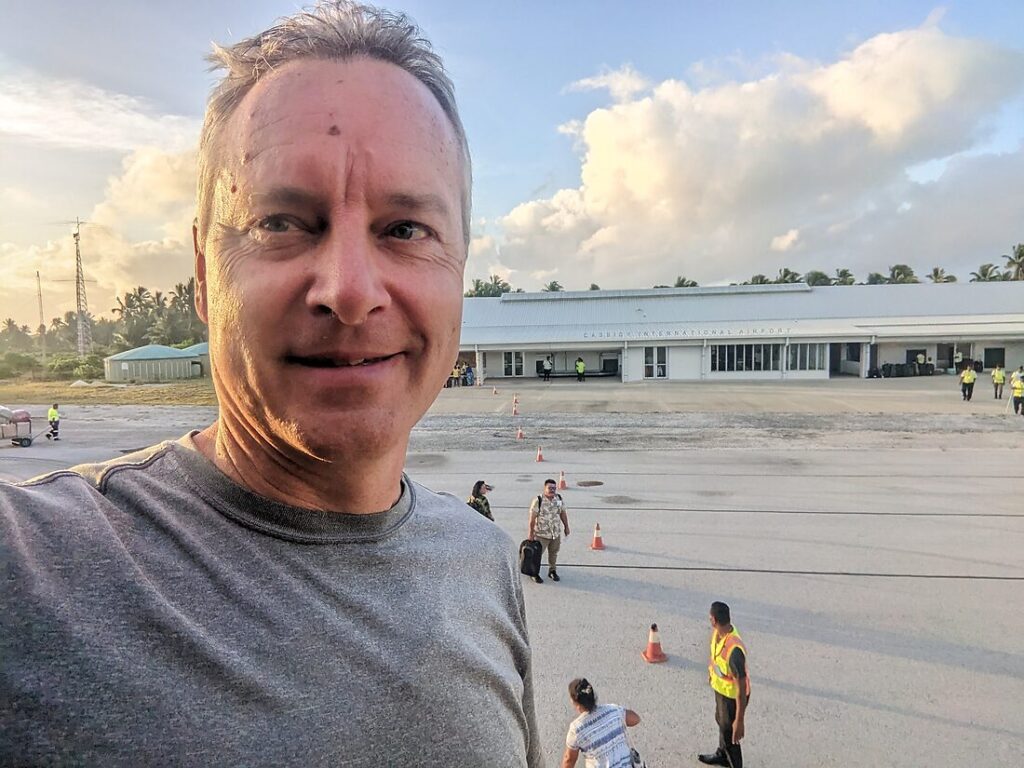
There are many ways to visit a country. Some people arrive with hiking boots, guidebooks, and a responsible plan.
I arrived in Kiribati strapped into an airplane seat while strangers lifted my seat cushion and sprayed the air around me.
This was not exactly the grand arrival I had imagined.
But travel has a funny way of expanding the definition of “I’ve been there,” especially when you are flying from Nadi, Fiji, to Honolulu, Hawaii, and the plane quietly drops out of the sky onto one of the flattest, most fascinating islands I have ever seen from above.
Technically, I went to Kiribati.
Emotionally, I am still arguing with myself.
Leaving Fiji After Everyone Else Had the Good Sense to Go Home
The trip began in Nadi, Fiji, late at night, which is not the ideal way to say goodbye to a place like Fiji.
Fiji deserves a dramatic farewell.
A golden sunset. A warm breeze. Someone handing you one last plate of food you did not ask for but absolutely needed. Maybe a small choir. At minimum, a palm tree silhouette.
Instead, I took off in the dark.
I was also alone, which made the whole thing feel a little stranger.
My family had already flown home two days earlier on a direct flight to Vancouver, which was the sensible, efficient, adult decision. They had returned to real life, real beds, and probably a functioning understanding of what day it was.
I, meanwhile, had stayed behind for more meetings.
That was the official reason.
The unofficial reason was that I had noticed Fiji Airways could get me to Hawaii with a stop in Kiribati, and apparently I am the kind of person who looks at a very long travel day across the Pacific and thinks, “Yes, but what if we made it weirder?”
I had planned trips for people to these islands before. I had read about them. I had looked at maps. And somewhere deep inside my travel-addicted brain, a tiny voice said, “You know, Normand, it would be nice to say you’ve actually been there.”
This is how reasonable people end up with unreasonable itineraries.
So while my family was already home, probably enjoying showers and vegetables and clocks that made sense, I was boarding an overnight flight from Fiji toward Hawaii with a small personal mission.
I wanted to see Kiribati.
Even if only for a moment.
Even if only through an airplane window.
Even if that moment involved seat cushions.
The Island That Looked Like It Was Drawn With a Pale Blue Pencil
Somewhere between sleep, snacks, and that strange airplane state where your neck no longer belongs to you, we began descending toward Kiribati.
More specifically, we were stopping at Kiritimati, also known as Christmas Island, which is served by Cassidy International Airport. It is one of those places that looks tiny on a map until you remember the Pacific is not a map. The Pacific is an enormous blue test of human scheduling confidence.
As we came in, I started taking aerial photos through the window.
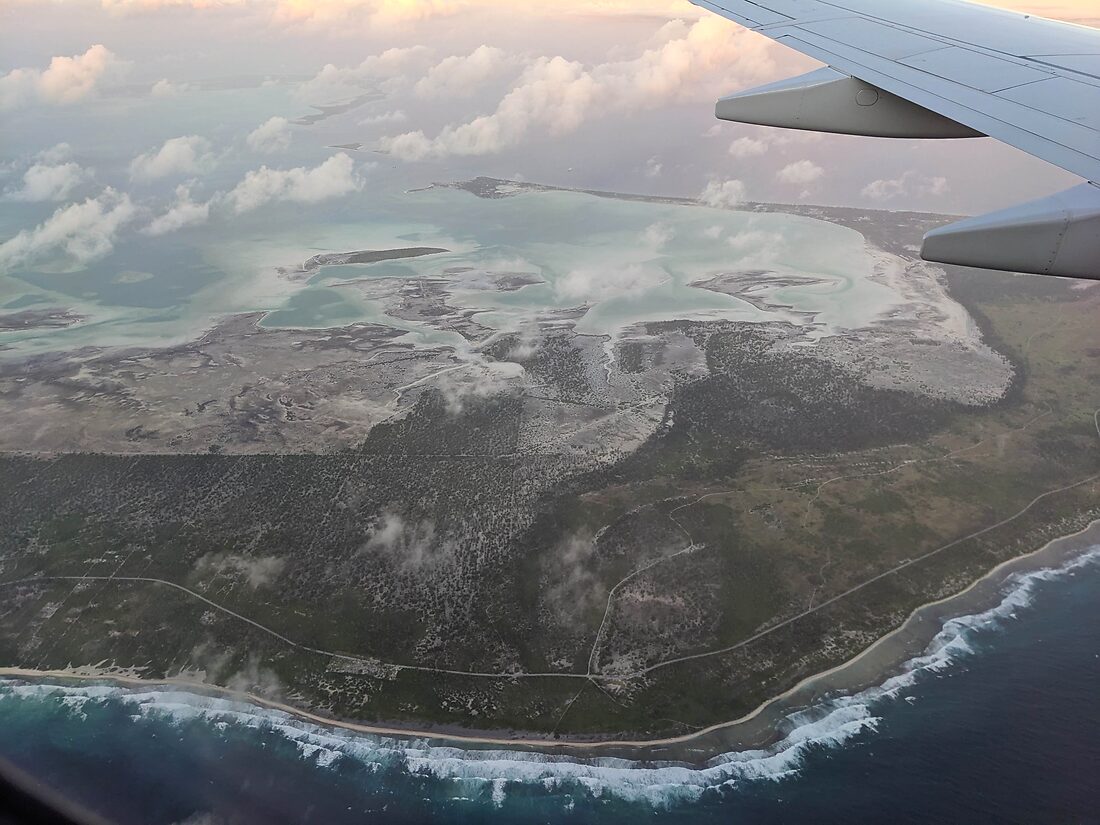
This is one of my airplane habits. Some people sleep. Some people read. I press my face toward the glass and take too many pictures of clouds, coastlines, wing tips, and mysterious little roads that I will later insist are “important visual documentation.”
Kiritimati was immediately different from almost anywhere else I have flown over.
It was so low. So flat. So delicate-looking.
From the air, the island seemed to float just above the ocean, like someone had drawn a thin line between blue and brighter blue. There were lagoons, reefs, pale sand, and long quiet stretches where land and water seemed to be negotiating who belonged where.
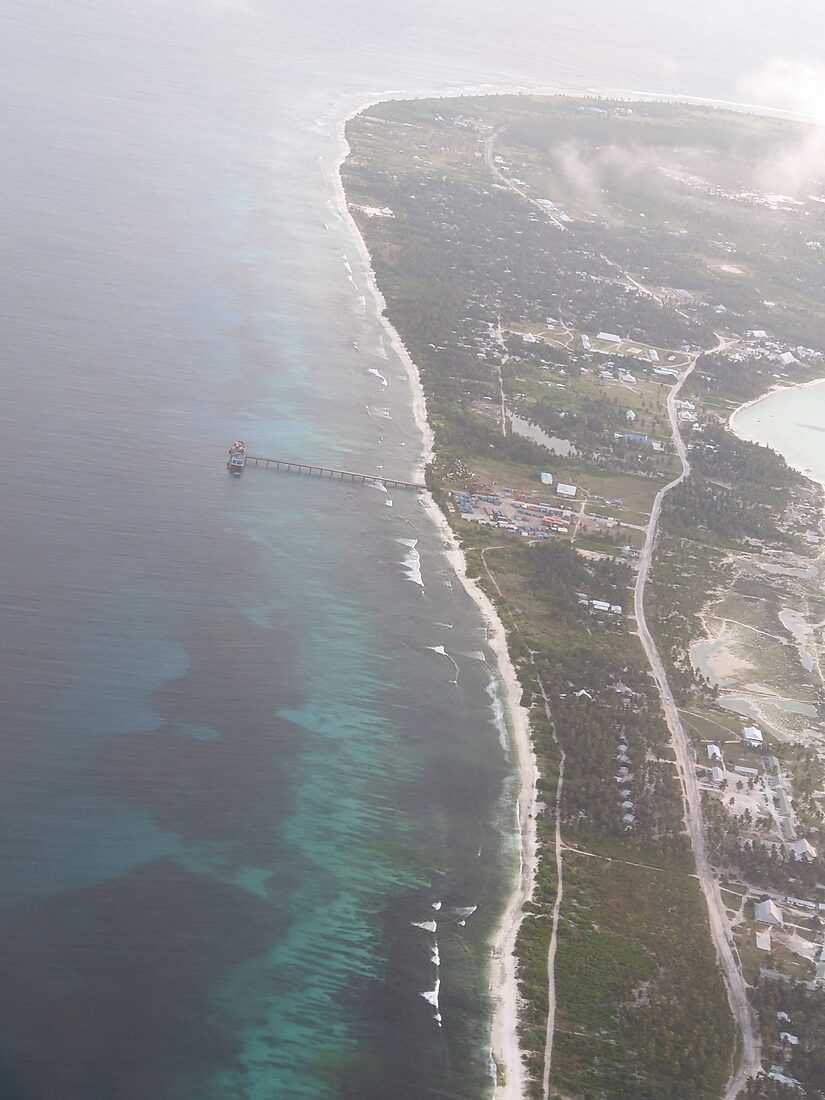
There were not towering buildings or big city clusters. Instead, I could see small communities, scattered roads, open spaces, and that unmistakable feeling of life adapted to a narrow, low-lying atoll in the middle of the Pacific.
It looked beautiful.
It also looked vulnerable.
There is something sobering about seeing a place like that from above. On a map, islands can look bold and permanent. From a plane window, Kiritimati looked impossibly thin, like the ocean had agreed to lend it space on a day-to-day basis.
I have helped plan trips for people to islands across the Pacific, including places like this. But planning a trip and seeing the actual shape of the land beneath you are two very different things.
A map says, “Here is an island.”
A window seat says, “Pay attention.”
My Grand Arrival, Featuring No Arrival
The plane landed, and for one brief, hopeful moment, I thought, “Maybe I can step off.”
Not explore, necessarily. I was not expecting a full expedition. I did not think anyone was going to hand me a coconut and say, “Normand, your island adventure begins now.”
But maybe I could at least put both feet on Kiribati soil.
Instead, the answer was basically: no.
A few people got off. A few people got on. The rest of us stayed on the aircraft, which meant my visit to Kiribati became a deeply philosophical matter.
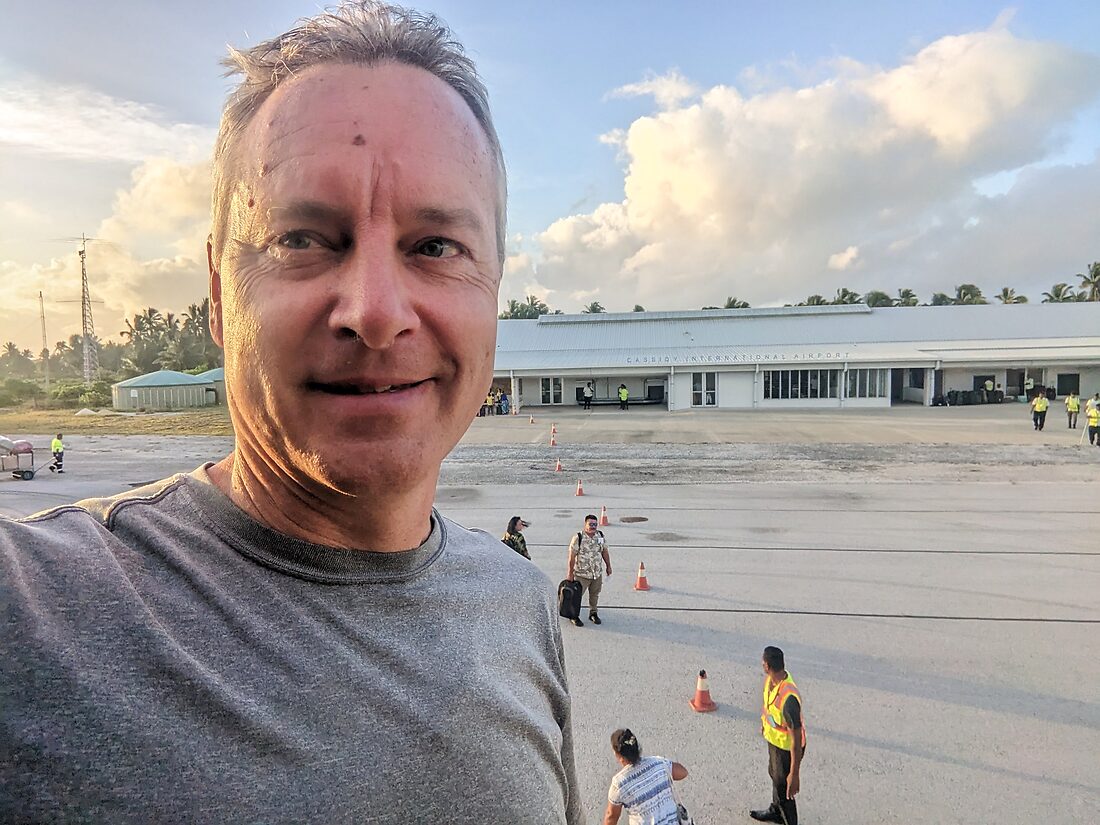
Was I in the country?
Yes.
Did I enter the country?
Not really.
Did I take a photo outside the plane?
Yes.
Does that count?
I have decided it counts enough for storytelling purposes, but not enough for my conscience. My conscience is very strict about island visits. It wants me to return, step off properly, and actually go exploring.
I respect that.
Also, I had not dragged myself across the Pacific, separated from my family, after meetings, through the night, just to be told this did not count at all.
I was claiming something.
Maybe not a full visit.
Maybe a travel asterisk.
But definitely something.
Then Came the Sprayers
Just when I thought the stop would be a quiet little island pause, the cabin became the stage for one of the funniest travel procedures I have ever witnessed.
People came through with small hand sprayers and sprayed the plane.
Now, there are serious reasons countries do this. Aircraft can carry insects and other tiny unwanted passengers between islands and countries, and some places are understandably careful about protecting agriculture, local ecosystems, and public health.
That is the official version.
The passenger version is this:
You are sitting there, half awake, somewhere in the Pacific, and suddenly someone walks by misting the air like the aircraft has become a very expensive houseplant.
I tried to look calm and internationally experienced.
Inside, I was thinking, “Should I breathe normally? Politely? In tiny sips?”
Then came the seat shuffle.
Everyone on the left side of the plane had to move over to the right side.
This sounds simple until you remember that airplane seats were not designed for sudden mass migration. They were designed to make your knees question your life choices.
So everyone shuffled across the aisle and squished together into the double seats on one side while the crew or officials went row by row on the empty side, lifting seat cushions and doing a thorough search.
Seat cushions came up.
Rows were inspected.
People leaned, twisted, clutched bags, and tried to look like this was all very normal.
I thought, “Okay, that must be it.”
It was not it.
Because once they finished that side, everyone on the right side had to get up and move over to the left side.
Of course we did.
At this point, the airplane had become a slow-motion game of human Tetris. People were squeezing past knees, balancing backpacks, apologizing to strangers, and trying not to accidentally sit on someone who had only moments earlier been enjoying personal space.
Then the other side got the same treatment.
Seat cushions up.
Rows checked.
More inspecting.
More shuffling.
More quiet laughter from people who had reached the point in travel where you simply accept that the plane is in charge now.
I still do not know exactly what they were looking for.
A misplaced item? Something connected to security or biosecurity? A suspiciously independent coconut? I have no idea.
All I know is that it was done seriously, thoroughly, and with the kind of calm efficiency that made the rest of us look like badly organized luggage.
And honestly, it was hilarious.
Not in a disrespectful way. Everyone was doing their job. But from the passenger perspective, trapped in the middle of the Pacific while being politely herded from one side of the airplane to the other, it was one of those moments where travel becomes absurd in the best possible way.
The Day That Would Not End
The stop added time to the journey. There is no way around that.
When you are flying from Fiji to Hawaii, you are already in the strange geography of long Pacific distances, time zones, datelines, and sleep schedules that no human body has formally approved.
Adding a stop in Kiribati made the trip longer, but also infinitely more memorable.
And then the International Date Line got involved.
This is where the day became ridiculous.
I left Fiji on May 8. I stopped in Kiribati on May 8. Then I crossed the International Date Line and arrived in Hawaii with even more May 8 waiting for me.
It was like the universe looked at my itinerary and said, “You seem like a man who could use several additional hours of the same day.”
Most people get 24 hours.
I got the extended director’s cut.
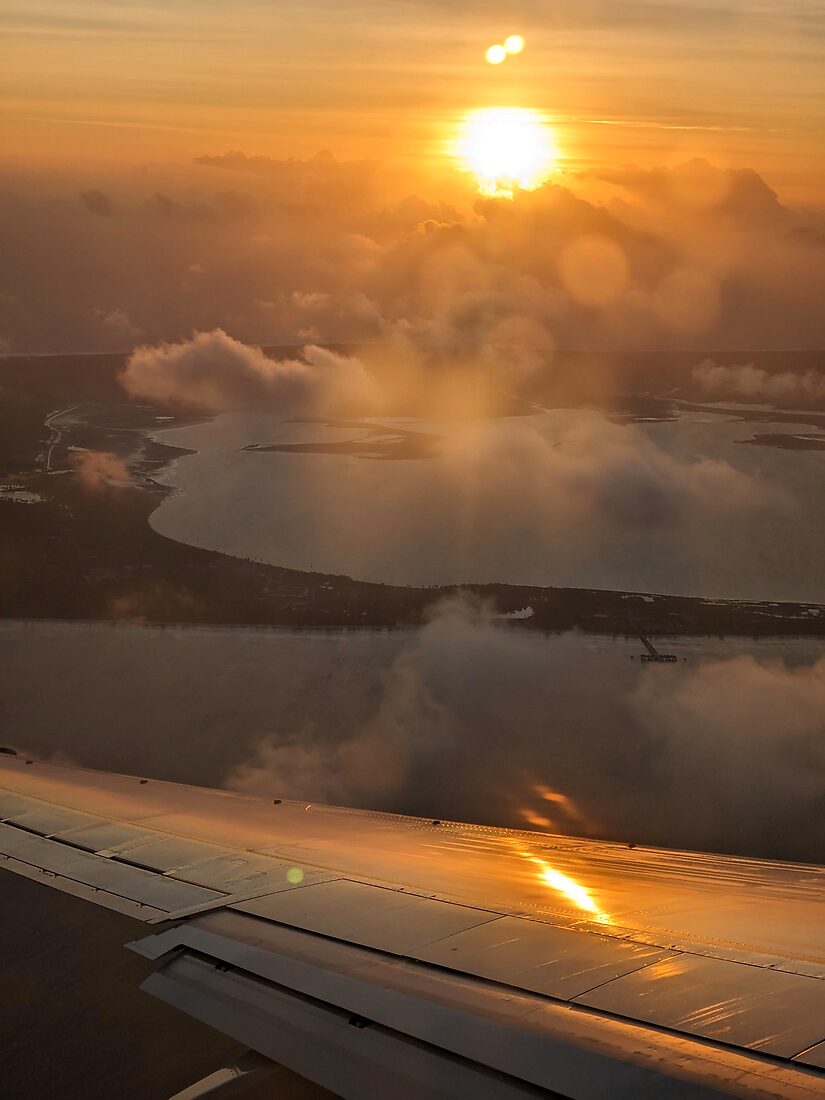
My family had flown home two days earlier, but somehow I was now living inside one extremely long travel day that refused to finish. It had meetings behind it, Fiji in the rearview mirror, Kiribati in the middle, Hawaii ahead, and Canada still waiting at the end like the final level of an airport video game.
Without the Kiribati stop, the flight would have been another overnight blur. A dark departure. A few meals. A stiff neck. A landing in Honolulu.
Instead, I got an aerial introduction to one of the most remote and visually striking places I have ever seen from a plane. I got a tiny glimpse of Kiritimati’s flat, fragile beauty. I got a photo outside the aircraft. I got a story involving sprayers, seat cushions, and an entire cabin of passengers playing musical chairs without music.
And I got to say, with several footnotes and a mildly guilty conscience, that I have been to Kiribati.
Although I am absolutely going back.
Next time, I want to step off the plane like a proper person. I want to see the island from ground level, not just from a window seat. I want to meet people, drive the roads I saw from above, look across the lagoons, and understand even a small piece of what life feels like there.
A country should not be reduced to a runway and a cabin spray.
Even if the cabin spray was extremely entertaining.
Hawaii, Borrowed Snorkels, and the Fastest Visit Possible
After Kiribati, we continued on to Hawaii.
Honolulu felt almost loud after that quiet island stop. Busy airport, warm air, familiar rhythm. I had about 18 hours before I would be back on a plane to Canada, which meant there was no time to waste and also no time to behave sensibly.
I visited family and friends, which is always the best reason to stretch a layover into a small adventure.
I also made it to Electric Beach for a snorkel.
There was only one small issue.
I did not exactly have snorkel gear.
Fortunately, the lifeguard had masks and snorkels in the lost and found, which is how I ended up borrowing aquatic equipment from the unofficial museum of things other people forgot.
This is not usually the recommended way to outfit an ocean adventure, but sometimes travel rewards flexibility. And mild shamelessness.
So I went for a quick swim.
The water felt like a reset button after the long flight. Fish below, sun above, salt on my face, and that wonderful feeling of stealing one small outdoor moment from a travel day that could easily have become nothing but airports and waiting rooms.
Then I headed up toward Laie on the North Shore to visit more family and friends.
Laie has always had that peaceful North Shore feeling to me. Green mountains, ocean nearby, slower roads, familiar faces, and the sense that Hawaii is giving you a deep breath even when your schedule is ridiculous.
And my schedule was ridiculous.
Because about 18 hours after arriving, visiting, snorkeling, driving, catching up, and pretending I was not tired, I was back on a plane to Canada.
By then, May 8 had become less of a date and more of a lifestyle.
Counting Countries, Counting Moments
I have learned that travel is not always clean and complete.
Sometimes you spend weeks in a place and still feel like you barely understood it.
Sometimes your family wisely flies directly home to Vancouver while you stay behind for meetings and then choose an itinerary that requires explaining to normal people.
Sometimes you spend 18 hours somewhere and the day feels full.
Sometimes you land in a country, remain on the aircraft, get sprayed, switch seats twice, take photos through a window, cross the International Date Line, snorkel with borrowed lost-and-found gear, visit friends, and somehow come away with a story you will never forget.
Kiribati deserves more from me than a runway stop.
But even that brief encounter stayed with me. The low island. The pale water. The small communities from above. The strange comedy of the cabin search. The reminder that the Pacific is vast, and every island in it has its own story, even when you only meet it for a moment.
So yes, I have been to Kiribati.
Sort of.
Technically.
With an asterisk.
And one day, I plan to return and remove the asterisk.