
November 14, 2024 • Norm
Day 1 — Casablanca Tried to Welcome Us With Trains, Tiny Taxis, and a Police Escort
There is a dangerous moment at the beginning of every family trip when everyone is still optimistic.
The bags have wheels. The children are still speaking to each other. Grandma is game for adventure. Dad has looked at the transportation options and said something reckless like, “This should be easy.”
That was me in Casablanca.
I had wanted to visit Morocco for years. I can’t say exactly what I expected, but in my mind it involved ancient cities, desert colors, mint tea, and perhaps someone wearing one of those red Fez hats that always look like they belong in a storybook. Morocco had been sitting on my travel wish list for a long time, waving politely from North Africa.
This time, I finally made it.
My wife unfortunately had to stay home at the last minute because of a family illness, so our Morocco adventure became me, my elderly mother, and three of my kids: Teyauna, Zakary, and Orin.
That is a good-sized travel team.
It is also the exact number of people required to turn a simple airport transfer into a small engineering project.
The Airport Transfer That Became a Group Character Test
Casablanca’s airport has a train station right inside it, which sounded wonderfully convenient. I like trains. Trains feel civilized. Trains suggest that a person has made a wise and economical decision.
This feeling lasted about seven minutes.
We waited roughly 45 minutes for the train, then rode it for about 35 minutes, which was fine except for the growing realization that our “easy” transfer was not racing toward success. By the time we arrived at the station nearer our hotel, we had already invested enough time that a taxi from the airport might have delivered us to our rooms, unpacked our bags, and possibly tucked us in.
But we were committed now.
This is one of the classic travel mistakes: continuing with the original plan long after the original plan has stopped deserving loyalty.
Our hotel was only about two kilometers away, but the official taxi wanted 100 MAD for the short ride. That is not an outrageous amount in the grand scheme of life, but when you know an app-based ride should be around 30 MAD, your brain suddenly becomes a stubborn accountant.
We tried inDrive, which is similar to Uber, except apparently not exactly legal in Casablanca. This may explain why the driver seemed allergic to stopping anywhere near the official taxi drivers. He circled, messaged, hesitated, and generally behaved like we were arranging a secret diplomatic extraction instead of a two-kilometer ride to a hotel.
Eventually, after far too much standing around with luggage and children, we negotiated a taxi for 70 MAD.
Then came the seating arrangement.
There were five of us.
The taxi had room for four passengers.
This did not stop anyone.
We folded ourselves into the car in the way families do when dignity has already left the building. Knees overlapped. Bags were wedged into mysterious spaces. Someone’s elbow was probably in someone else’s rib cage. My mother, who has reached the stage of life where she deserves roomy transportation and applause, was instead squeezed into our rolling Moroccan introduction like a human game of Tetris.
Thankfully, it was not far.
Travel lesson number one in Morocco: sometimes the cheapest option is not the cheapest once you include time, confusion, and the emotional cost of pretending your legs still work.
Pizza, Because Civilization Requires Bread and Cheese
We finally reached the Hotel Campanile on the edge of Casablanca, dropped off our bags, and went in search of food.
This was not a leisurely culinary exploration. This was survival.
Down the street, we found a small local pizza and sandwich place. It was simple, busy, and filled with locals, which is usually one of the best signs a hungry traveler can find. Tourist restaurants often have better lighting and higher prices. Local places have people who actually know where to eat.
The pizzas were about 45 MAD each, roughly $4.50, and they tasted exactly like victory.
After a long travel day, there are few things more beautiful than affordable food appearing quickly. I do not remember every topping. I do remember the feeling of sitting down, eating something warm, and realizing that Morocco had not defeated us yet.
It had only tested our taxi flexibility.
By the time we finished dinner, it was around 9 p.m. A sensible family would have gone back to the hotel and slept.
We were not sensible.
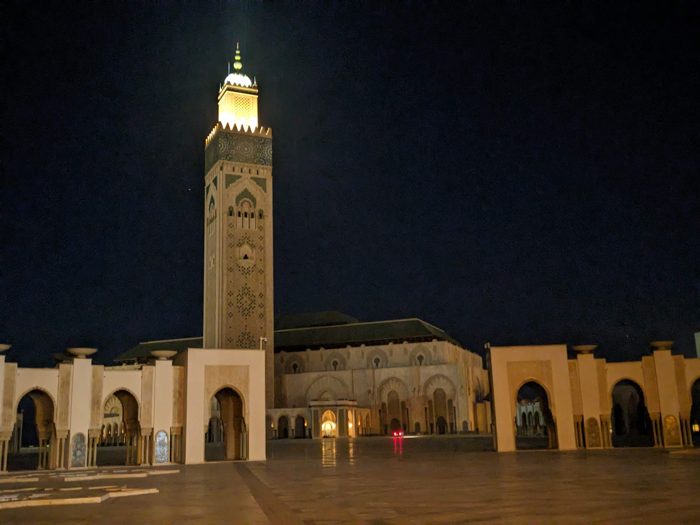
We had only one evening in Casablanca, and I could not bear the thought of leaving without seeing at least one major landmark. The Hassan II Mosque was about 30 minutes away, and it is one of the largest mosques in the world, with the world’s tallest minaret.
So naturally, after a long flight, a questionable train decision, a squishy taxi ride, and dinner, I said, “Let’s go see the mosque.”
This is why children eventually learn to question their parents.
The Mosque Was Closed, Which Was Reasonable
We ordered another inDrive into the main city, because apparently one suspicious ride experience was not enough for us.
The driver picked us up with the same energy as someone smuggling library books across a border. He did not want to stop in obvious places. He encouraged us to hurry in and out. He avoided main roads when possible. The whole thing had a faint spy-movie feeling, except the spies were sleepy tourists carrying phones and asking where to take photos.
When we reached the Hassan II Mosque, it was, of course, closed.
This should not have surprised anyone. It was late at night. Major religious sites do not generally remain open indefinitely just because a Canadian family arrives with poor timing and optimistic camera batteries.
Even the enormous plaza around the mosque had barriers blocking access. Police cars moved through the square, making sure the area stayed clear.
Still, the mosque was stunning.
Even from outside the barriers, the minaret rose into the night like a lighthouse made of stone and devotion. The building sat near the Atlantic, grand and quiet, lit against the dark sky. It had the kind of presence that makes people lower their voices without being told.
Then Orin spotted a security guard.
I am not entirely sure what was said, but somehow the guard invited us onto the plaza for a photo.
At first, we stepped in only about ten feet, which felt daring enough. Then he motioned for us to come farther. Apparently, if you are going to break the imaginary line, you might as well get a better angle.
So there we were, standing in front of one of the most impressive buildings in Morocco, trying to take a quick photo while also looking like people who absolutely belonged there.
We did not.
A police car with its lights on drove up almost immediately.
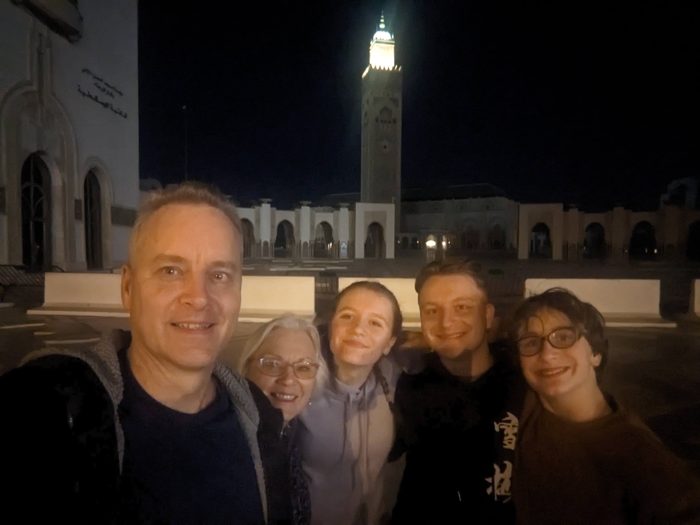
The officer spoke to the security guard, and then we were told to clear the square.
Fair enough.
We had been given a tiny window of grace, just enough time for a photo or two, and then the plaza returned to its proper, empty nighttime dignity. I still wonder whether the security guard got in trouble for letting us in. I hope not. He gave us a small gift at the beginning of our trip, and I appreciated it more than he probably realized.
Travel lesson number two: sometimes the best travel moments happen in the 45 seconds before someone official tells you to leave.
Casablanca by Night, Mostly Seen by One Awake Person
After the mosque, our driver took us along Casablanca’s waterfront. The Corniche passed by in lights, dark ocean air, restaurants, cafés, and the blur of a city we barely had time to meet.
Casablanca is not the postcard Morocco most people imagine. It is big, busy, modern, practical, and full of movement. We were only touching the edge of it, but even that edge had energy.
Inside the car, however, the energy was fading fast.
One by one, the kids surrendered.
Teyauna fell asleep. Zakary fell asleep. Orin fell asleep. My mother may have been quietly conserving energy in the way only experienced travelers know how to do.
By the time we returned to the hotel, I think I was the only one still fully awake in our illegal ride. The driver again avoided dropping us somewhere too obvious, because heaven forbid the police catch him transporting a family who looked like they had just lost a wrestling match with public transportation.
We climbed out, gathered our sleepy crew, and shuffled back into the hotel.
It had been only our first day in Morocco, but already we had learned several important things.
The train is not always faster.
The legal taxi is not always cheaper.
The illegal taxi is not always relaxed.
Local pizza can save morale.
And if a security guard waves you closer to one of the world’s great mosques at night, take the photo quickly.
Casablanca did not give us a polished first impression. It gave us a cramped, funny, slightly chaotic, beautifully lit one. And honestly, that felt more fitting. Family travel rarely begins with perfect logistics. It begins with tired people, questionable choices, and one moment that makes everyone say, “Well, we’re definitely here now.”
Morocco had opened the door.
Not smoothly.
But memorably.
In the next installment, we leave Casablanca behind and head toward Fes, with Roman ruins, a cooperative meal, and the beginning of Morocco’s deep dive into history, music, and children being pulled into performances they did not see coming.