
November 23, 2024 • Norm
Day 9 — Cairo Gave Us Pyramids, Police Whistles, and a Sleeper Train With Character
There are mornings when a 6:15 a.m. alarm feels like a suggestion.
This was not one of those mornings.
This was Cairo. This was pyramid day. This was our only real chance to stand in front of one of the most famous ancient wonders on earth, so the alarm could not be ignored, negotiated with, or thrown gently across the room.
Our suitcases had to be outside the room by 6:30 a.m. Breakfast was waiting. The bus was leaving by 7:15. And my children, for reasons known only to teenagers and sleep scientists, were not behaving like people deeply concerned about ancient history.
Zakary had to be dragged out of bed.
Teyauna slept in as long as humanly possible and made it to breakfast just before we had to leave.
This is family travel at its finest: one parent watching the clock, one child chewing breakfast with the urgency of a sloth, and one of the world’s greatest archaeological sites waiting patiently in the desert.
The Great Pyramid Does Not Ease You Into Things
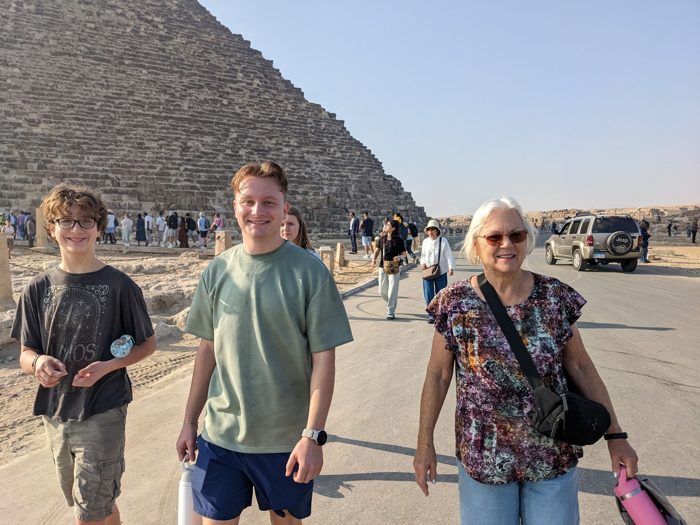
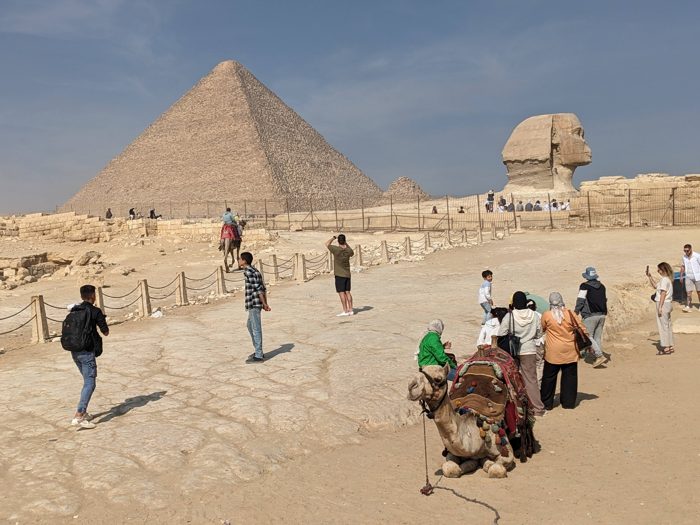
We arrived at the Great Pyramid of Giza as crowds were beginning to gather.
There it was.
Massive.
Ancient.
Famous.
And somehow still surprising.
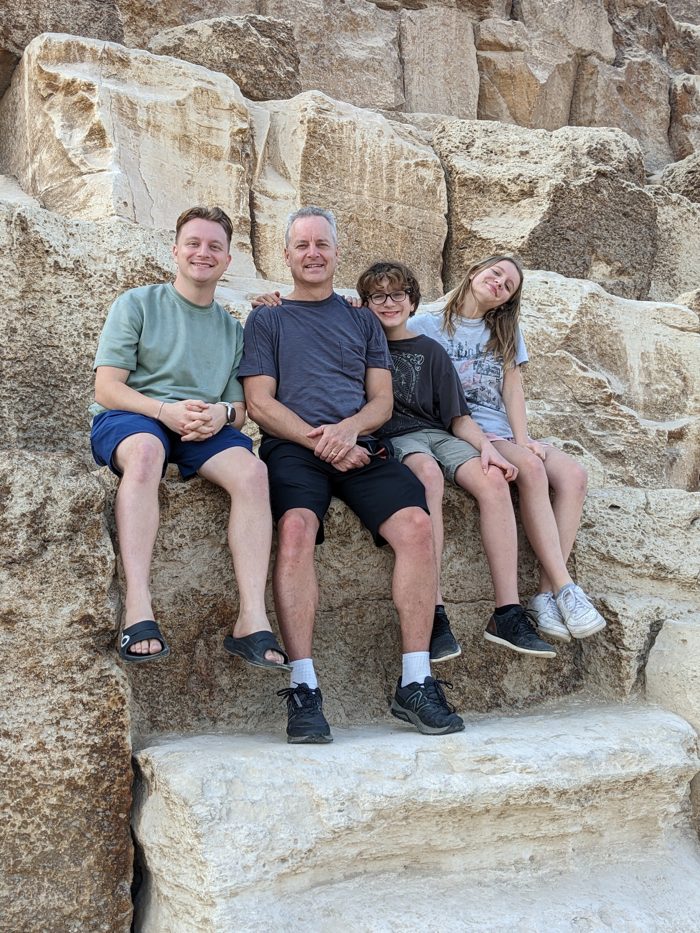
I had seen photos my entire life, but photos do not prepare you for the size of the stones. Each block looked less like a building material and more like something a small vehicle might struggle to move. Standing beside the pyramid, you understand why people have spent thousands of years staring at it and asking, “How exactly did they do this?”
Zakary’s first instinct was to climb.
This is understandable from a child’s perspective. The pyramid looks like a giant stone staircase built by ancient people who clearly did not consult modern liability forms.
He made it about five levels up before a police officer began whistling sharply and motioning him down.
To Zak’s credit, he had not gone very high.
To the officer’s credit, he had clearly seen enough tourists with poor pyramid judgment to act quickly.
So Zak came down, and I added “child almost disciplined by pyramid police” to the growing list of travel memories I did not know I needed.
The pyramid itself was overwhelming. Not delicate. Not polished. Not distant behind glass. Just enormous and present, sitting there under the Egyptian sun like it had nothing left to prove.
Which, after more than 4,000 years, it probably does not.
Camel Rides, Viewpoints, and Knowing When to Say No
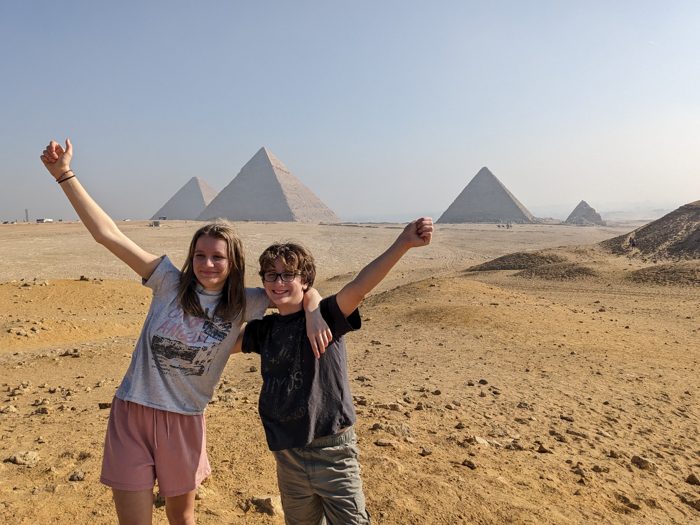
Our next stop was a viewpoint overlooking the three main pyramids.
This is the classic panorama: the Great Pyramid, the slightly smaller one, and the smallest one lined up across the desert plateau. Our guide described them as the grandfather, father, and grandson pyramids, which made the whole scene feel like a family portrait in stone.
The viewpoint was busy.
Very busy.
There were vendors, camel ride operators, tourists, guides, and people calling out offers from every direction. Some in our group decided to take camel rides, which normally might have tempted us.
But we had just ridden camels in the Sahara Desert the previous week in Morocco.
That experience had involved dunes, quiet, misty rain, and enough time to feel peaceful.
This experience looked more like camel rush hour.
So we passed.
Instead, we wandered around taking photos, enjoying the view and trying to absorb the fact that we were standing in front of one of the most recognizable landscapes in human history.
Travel sometimes creates strange comparisons. One week earlier, camels in Morocco had felt like a magical desert caravan. In Cairo, the camels felt more like an aggressive transportation menu.
Both are real.
One was simply more our speed.
Inside the Pyramid: Narrow Passageways and Ancient Claustrophobia
Our third stop was the smallest of the three main pyramids, where we had bought tickets to enter the burial chamber.
This was one of those experiences that sounds simple until you are actually doing it.
You enter through a narrow passageway, bending slightly, walking downward into the center of the pyramid. The air becomes warmer and stiller. People pass in both directions. Everyone is trying to be patient while also privately wondering whether ancient Egyptians considered personal space.
The passage opened into a taller hallway and then into a chamber. From there, we went down more stairs to another chamber where the mummified bodies would once have been placed.
There was someone inside offering to take photos for a tip.
We had been advised to ignore him.
This is easier said than done in a small ancient burial chamber where ignoring someone feels less like a casual choice and more like a group exercise in awkward eye contact avoidance.
Zak really wanted to take a 360-degree photo inside, which took a little time because people were constantly moving in and out of the chamber.
I understood why he wanted it.
There are places where a normal photo does not quite capture the feeling. Inside the pyramid was one of them. The tight passage, the stone walls, the strange stillness, the knowledge of where you were — it felt less like sightseeing and more like temporarily stepping into the imagination of an ancient civilization.
A hot, crowded imagination.
But still remarkable.
The Sphinx Is Smaller Than Expected and Still Completely Iconic
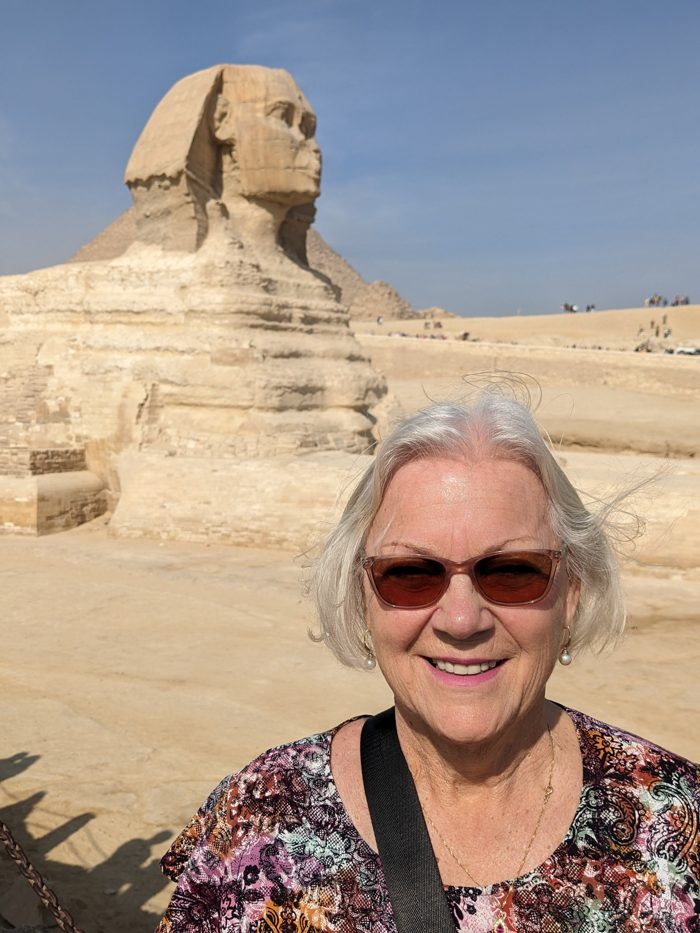
Our final stop in the Giza area was the Sphinx.
The Sphinx is one of those monuments that lives so strongly in your mind that seeing it in person feels slightly unreal. It has the body of a lion and the head of a pharaoh, although in my original tired brain I kept thinking jackal, which is exactly the sort of mistake ancient Egypt likes to punish with more museum time.
It was smaller than I expected, but still powerful.
The pyramids tower behind it, and the whole scene feels almost too famous to be real. Tourists gathered in all the predictable photo spots, trying to line up hands, kisses, angles, and poses with the patience of people who have seen the same Instagram idea 4,000 times and still want their own version.
We took our photos too.
Because of course we did.
Some travel clichés exist because the place really is worth seeing.
The Museum, the Mask, and the Longest Day
After Giza, we stopped at an overpriced buffet restaurant on the way to the Egyptian Museum near Tahrir Square.
By this point, we were hungry enough to forgive many things.
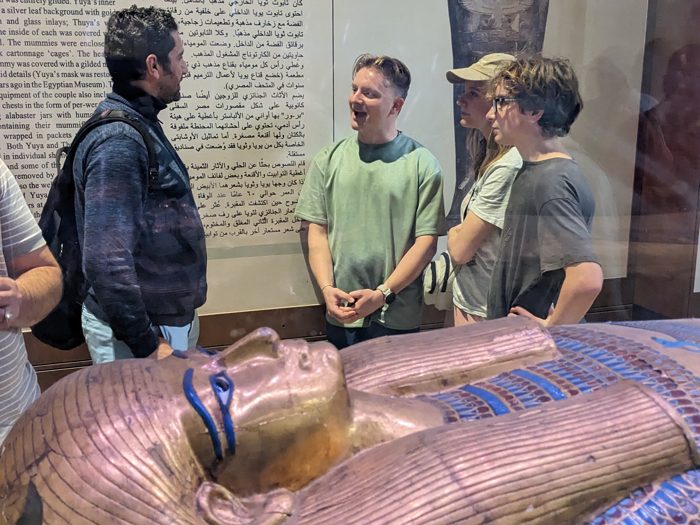
The museum still held many important artifacts, even though a large number had been moved to the newer museum. We saw mummies, sarcophagi, tomb artifacts, jewelry, King Tut’s gold mask, and a replica of the Rosetta Stone.
The gold mask was the highlight.
It is one of those objects you have seen in books, documentaries, posters, and school projects, but standing in front of it is different. It is detailed, beautiful, and haunting in the way ancient objects can be when they have somehow survived centuries of human chaos.
The museum was full, and so was the day.
By the time we returned to the hotel, we were given a small room to shower and freshen up before heading to the train station around 7:30 p.m.
A shower after a full Cairo touring day is not a luxury.
It is a rebirth.
The Beautiful Station and the Train With Opinions
The train station was surprisingly modern and beautiful. It had opened only a couple of weeks earlier and looked bright, organized, and full of nice shops for snacks.
Then we boarded the train.
The sleeper train to Aswan was a different story.
It was functional, but tired. Very tired. The furniture looked like it had been through several decades of loyal service and was now quietly hoping for retirement.
Every two people in our group were assigned a sleeper car. The spaces were tight. The hallway allowed single-file movement, which gave the whole train a submarine-like quality, except with more rice and chicken.
Dinner was simple: rice and chicken served in our compartment. Later, the train steward came by to turn down the bunk beds.
He was friendly and accommodating, even though he did not speak much English. He smiled often and made sure we were taken care of, which goes a long way when you are on a train that appears not to have been redecorated since the invention of fax machines.
There was no real lounge area, so people either gathered awkwardly in small rooms or stood in the hallway like polite human bookmarks.
Everyone went to bed early.
There was not much else to do.
And honestly, after pyramids, police whistles, burial chambers, the Sphinx, a museum, a shower, and a sleeper train, bed felt like the only remaining ancient wonder I truly needed.
Cairo had given us a huge first day.
Not gentle.
Not easy.
But unforgettable.
In the next installment, we arrive in Aswan, visit the island temple of Philae, discover that “free massage” is sometimes a sales strategy, and end the day with a Nubian dinner hosted by someone who remembered my name from eight years earlier.