
November 19, 2024 • Norm
Day 6 — Ait Ben Haddou Looked Like a Movie Set Because It Basically Was
There are some places that feel ancient.
There are some places that feel cinematic.
And then there is Ait Ben Haddou, which somehow manages to look like both an archaeological site and a film director’s dream board.
We left Todra Gorge early in the morning and began another driving day through Morocco’s changing landscapes. By this point in the trip, packing and unpacking had become a family sport. Everyone had their system, which mostly involved shoving items into bags and hoping the zipper still believed in miracles.
We were heading toward Ait Ben Haddou, a UNESCO-listed fortified village that has appeared in more movies and shows than some professional actors.
It was also, apparently, where parts of Gladiator 2 had been filmed months earlier.
I kept my expectations reasonable.
I was not expecting Russell Crowe.
Also, wrong movie.
The View From Across the Valley
Our first stop was at a scenic viewpoint across the valley from Ait Ben Haddou.
From there, we could see the old city rising from the earth in layers of clay-colored walls, towers, and narrow passages. It looked like it had grown directly out of the hillside rather than been built on it.
The whole place blended into the landscape so naturally that it almost seemed camouflaged.
In the distance, Ait Ben Haddou looked quiet and timeless. The kind of place where you expect a caravan to appear, or a movie crew, or a tourist holding a phone in one hand and a bottle of water in the other.
We were, of course, the third option.
There were no visible remnants of the movie production. No abandoned props. No dramatic signs saying, “A famous scene happened here.” Just the ancient-looking city, a few tourists, and the soft colors of Morocco stretching around it.
That was probably better.
Sometimes places are more impressive when they are allowed to be themselves instead of reminding you who filmed there.
The City Without Much Electricity but Plenty of Character
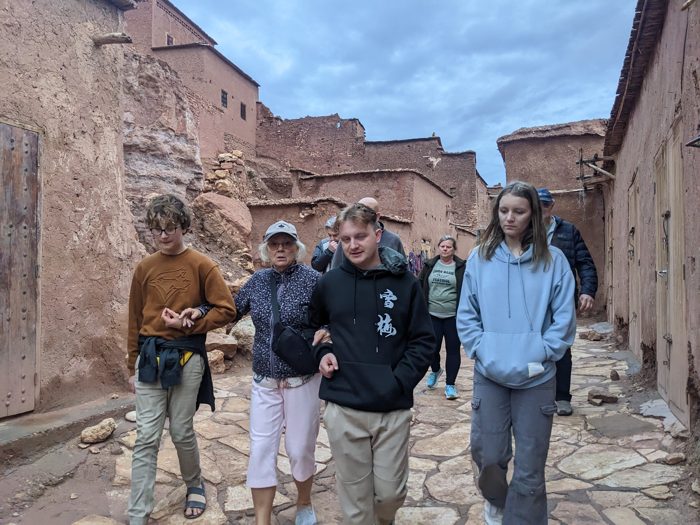
We crossed into the old village and began climbing through its narrow streets.
Ait Ben Haddou is built from earthen materials, with walls and towers that feel fragile and strong at the same time. It is one of those places where you become very aware of weather. Rain, sun, wind, and time all matter here. The buildings are not polished stone monuments. They are living reminders of how people adapted to the land around them.
Many of the shops still did not have electricity, which gave the place a different rhythm.
Vendors sold souvenirs from small stalls and tucked-away spaces, offering scarves, art, trinkets, and the usual things travelers suddenly consider buying when they are far from home.
This is another strange travel law: the farther you are from practical luggage space, the more appealing fragile souvenirs become.
We wandered up through the winding paths, passing mudbrick walls, small doorways, and viewpoints opening across the valley. Every few steps, the angle changed, and the village revealed another part of itself.
It was easy to understand why filmmakers love it.
Ait Ben Haddou does not need much help looking dramatic. You could point a camera almost anywhere and convince people something important was about to happen.
A horse could appear.
A battle could begin.
A slightly tired Canadian family could climb some stairs while wondering when lunch was.
All equally cinematic in their own ways.
The Climb to the Top
We continued up the mountainside steps to the viewpoint at the top.
By this stage of the trip, stairs had become a recurring theme. Ancient cities love stairs. Desert viewpoints love stairs. Historic sites love stairs. My knees were beginning to suspect a conspiracy.
But the climb was worth it.
From the top, we could see the valley spread below us, the old city descending in layers beneath our feet, and the surrounding landscape stretching outward in dusty browns, reds, and golds.
There is something rewarding about climbing to the highest point in a place like this. Not just because of the view, but because it helps you understand the shape of the place. From below, Ait Ben Haddou feels like a maze. From above, it becomes a story of walls, paths, towers, and survival.
People built here for reasons: protection, trade, shelter, and visibility.
Also, presumably, to make future tourists sweat a little.
The kids handled the climb well, which made me suspicious. Children can complain dramatically about walking five minutes to a restaurant, then climb a historic hill without much concern if the location feels adventurous enough.
I have yet to fully understand the formula.
The Beauty of a Shorter Day
Compared with the Sahara days, this day felt calmer.
There was still driving. There was still walking. There were still stairs. But there was also space in the schedule to breathe.
After visiting Ait Ben Haddou, we had free time in the evening at the hotel. That may not sound exciting, but after several days of constant movement, hotel downtime becomes luxurious.
Nobody had to rush to a show.
Nobody had to mount a camel.
Nobody had to negotiate with a taxi driver behaving like he was in an undercover operation.
We could simply rest.
This is an underrated part of family travel. You can only absorb so much wonder before your brain starts replying, “That’s nice, but I would also like to sit down.”
The evening gave us a chance to recover before the final stretch toward Marrakech. Bags could be reorganized. Batteries could be charged. Everyone could enjoy the rare pleasure of not immediately needing to be somewhere else.
Even adventure needs pauses.
When the Cameras Leave
What stayed with me about Ait Ben Haddou was not the movie connection, though that was fun.
It was the way the place looked like it belonged exactly where it was.
Some famous locations feel famous. They seem aware of their own reputation. Ait Ben Haddou felt quieter than that. Yes, tourists came. Yes, vendors sold souvenirs. Yes, movies had used its dramatic walls and ancient texture.
But beneath all of that, it still felt rooted.
A place shaped by sun, clay, trade routes, families, weather, and time.
We had only a short visit, but it was enough to feel the pull of it. Enough to imagine caravans arriving. Enough to understand why stories keep finding their way there.
And enough to remind me that sometimes the best travel days are not the loudest ones.
Sometimes the good days are the ones where you climb an old hill, look out over a valley, take a deep breath, and then go back to the hotel with no dramatic crisis to report.
Though, to be honest, a small dramatic crisis often does make for better writing.
In the next installment, we cross the Atlas Mountains toward Marrakech, where the air turns cold, the markets come alive, the snake charmers appear, and our family makes the bold cultural decision to order hamburgers and tacos.