
November 18, 2024 • Norm
Day 5 — Sunrise in the Sahara, Dune Bashing, and the Hotel Pool Nobody Asked For
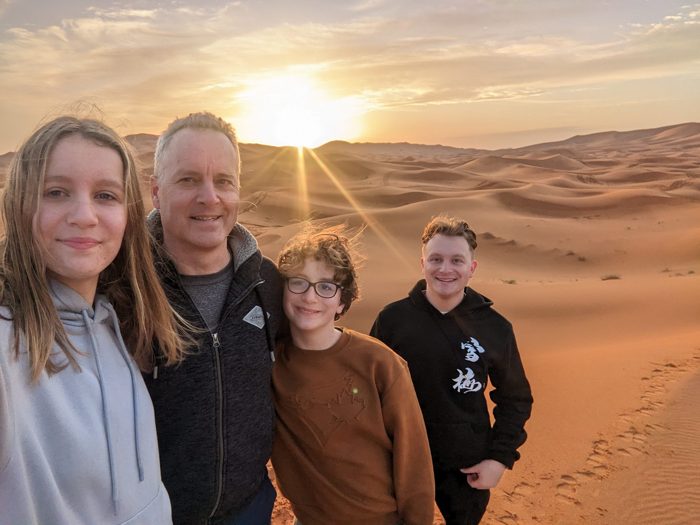
There are few things that will get me out of bed early on vacation.
A flight, unfortunately.
A buffet breakfast with good pastries, possibly.
A sunrise over the Sahara Desert, absolutely.
After our cloudy, misty camel ride the night before, I was determined to see the desert in the morning light. I had fallen asleep far too early, which meant I was awake by 5 a.m., staring into the darkness with that strange travel feeling of being both exhausted and excited.
By 7 a.m., the sky had started to brighten, and I gathered the kids for a walk into the dunes.
This sounds peaceful.
It was also exercise.
Climbing Sand Is a Humbling Experience
The dune looked manageable from a distance.
This is one of the Sahara’s tricks.
Sand dunes appear smooth and inviting, like nature has kindly arranged a soft walking path for you. Then you take five steps and realize your legs are doing twice the work for half the progress.
Every footstep sank. Every slope stretched longer than expected. The kids, naturally, moved like they had been raised by desert foxes. I moved more like a man negotiating with his knees.
We climbed toward the tallest dune we could find and arrived just in time for sunrise around 7:50 a.m.
And then the Sahara did what the Sahara does.
The sun broke over the horizon, spilling gold across the waves of sand. The dunes shifted from gray to amber to deep orange, with shadows pooling in the valleys between them. It was quiet in a way that felt almost physical. No traffic. No crowds. No music. Just wind, sand, and the kind of beauty that makes everyone stop performing for the camera for a few seconds.
Even the kids felt it.
Briefly.
Then Orin and Teyauna started filming their own little scene inspired by Dune, running across the ridges and creating dramatic footprints in the untouched sand.
Zakary, meanwhile, was doing what Zakary does best: burning energy at a level that makes adults question basic biology.
The wind had erased most of the footprints from the night before, so the dunes felt fresh and untouched. There is something deeply satisfying about stepping onto smooth sand and knowing you are the first person to leave a mark there that morning.
There is also something mildly embarrassing about leaving a trail that clearly shows where you paused to catch your breath.
Gnaoua Music and the Excursion That Could Have Used a Pause Button
After breakfast, we packed up and headed out on a 4×4 excursion around Merzouga.
Our first stop was Khamlia, a village known for Gnaoua music and culture. We sat and listened to a performance of rhythmic music, drums, clapping, and singing that carried the deep sound of a tradition being kept alive through tourism.
It was meaningful and interesting.
It also went a little longer than expected.
This is one of the challenges of group travel. You are balancing appreciation with schedule, culture with logistics, and the quiet voice in your head saying, “This is wonderful,” with the other voice saying, “Aren’t we supposed to be somewhere else by noon?”
Eventually, we slipped out and continued onward.
Our next stop was an oasis lake in the desert. To get there, we drove along what looked like a dried riverbed, winding between rocks and sand until water suddenly appeared in the middle of all that dryness.
The desert is good at surprises.
One minute everything is dust and stone. The next, there is a lake, looking like it was placed there by someone with a strong sense of contrast.
We stopped for photos, then moved on to an old silica mine. Deep holes cut into the rocky ground, and a few vendors had set up nearby, selling souvenirs to the occasional tourist. Morocco had a way of reminding us that even in remote places, someone might still be ready to sell you a trinket.
I respect the commitment.
Bread, Sand, and the Roller Coaster Without Seatbelts
From there, we visited a Bedouin camp where a woman was cooking flatbread in a clay oven.
The bread was warm, simple, and memorable in the way fresh bread almost always is. A few children came by with coins for food, and tourists were also welcome to try some and leave a small tip.
The camp itself made me pause.
The shelters were made from fabric, scraps, and whatever materials could create shade and protection from the desert. It was humble and practical, shaped by heat, sand, and limited resources. Travel sometimes brings you into places that make you think about how differently people live, and how much of what we consider necessary is really just comfort we have grown used to.
Then, after that quiet moment, our driver deflated the tires.
This is when the day changed personalities.
Suddenly we were dune bashing.
The 4×4 roared into the sand, climbing and sliding over dunes like a roller coaster that had lost interest in tracks. The flattened tires gripped the soft sand, and we could feel the vehicle shift beneath us as the dunes gave way.
The kids loved it.
I loved it too, though in a slightly more aware-of-my-mortality way.
We bounced, climbed, slid, and laughed our way across the dunes. Near the end, the kids tried a bit of sandboarding, sitting on a board and sliding down a steep dune like a desert toboggan.
We would have loved more time for that. Four hours would have been ideal for the excursion, especially if we had shortened the first stop. But we had to be back at the hotel by noon to continue the day’s drive.
This is the blessing and curse of a packed trip. You see so much. You also occasionally have to leave places just as they are getting really fun.
From Sand Dunes to Red Rock Walls
After leaving Merzouga, we began the drive toward Todra Gorge.
It took about three hours, plus a lunch stop, and by the time we arrived, the scenery had changed again.
Morocco is very good at changing costumes.
The golden dunes gave way to rocky landscapes, and then to the towering red walls of Todra Gorge. The gorge was narrow and dramatic, with cliffs rising steeply on both sides. It is a popular area for mountain climbers, and it was easy to see why. The rock faces looked like they had been designed to make adventurous people say, “I can climb that,” while the rest of us say, “I can photograph that from the ground.”
We took a short walk through the gorge, admiring the scale of the red cliffs and the cool air between them. After the openness of the Sahara, the narrowness of the gorge felt almost theatrical.
Nature had built a corridor and then decorated it with stone.
Our hotel was only a short drive away, and by evening we finally had a little time to rest.
Zakary, however, looked at the hotel’s cold outdoor swimming pool and thought, “Yes. This is what I need.”
I looked at the same pool and thought, “Absolutely not.”
It was sweater weather. I turned up the heat in my room and got a bit of work done instead, which felt like the correct adult decision. Zak went swimming, which felt like the correct Zak decision.
Dinner had to be preordered two hours in advance, a reminder that in more remote areas, meals do not always appear instantly just because travelers are hungry. But that was fine. We had internet again, warm rooms, and the satisfaction of having started the day with sunrise in the Sahara and ended it below the cliffs of Todra Gorge.
That is a lot for one day.
The Sahara had given us silence, sunlight, music, bread, speed, and sand in places we would be finding for days.
And Todra Gorge had welcomed us with stone walls, cool air, and one child willing to swim when every sensible adult had chosen survival.
In the next installment, we head toward Ait Ben Haddou, an ancient mudbrick city famous for movies, history, and the strange feeling that you have walked onto a film set even when the cameras are gone.