
November 17, 2024 • Norm
Day 4 — The Sahara Was Supposed to Give Us a Sunset. It Gave Us Camels and Rain Instead
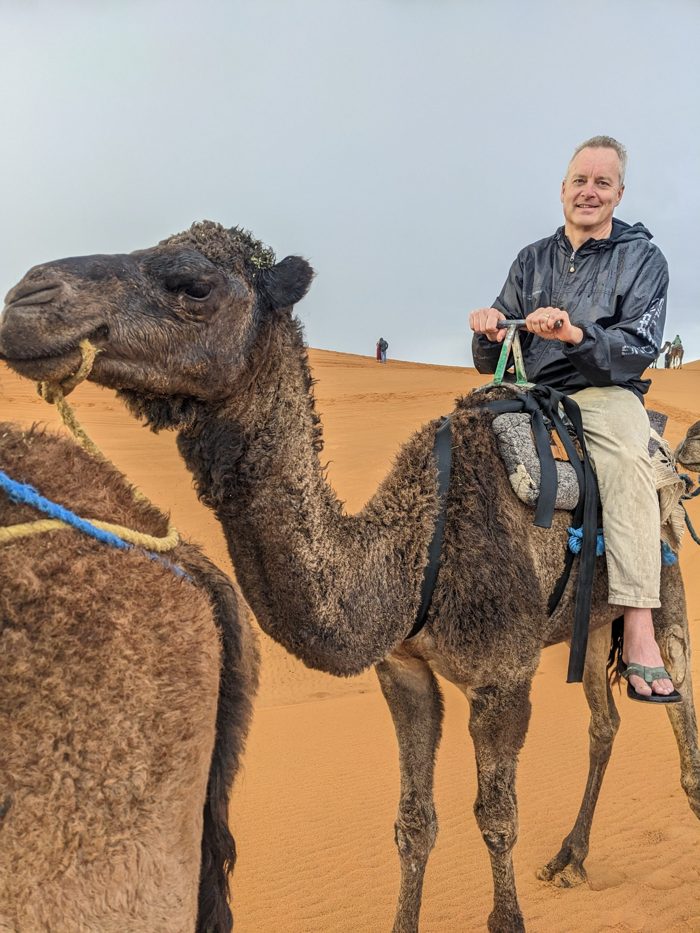
There are many ways to prepare for an eight-hour drive through the Atlas Mountains.
Sleep well.
Pack snacks.
Use the bathroom whenever possible.
And never underestimate the emotional power of knowing that camels are waiting at the end.
We started early from Fes with breakfast around 6:30 a.m. and departure at 7:00. This was not one of those lazy vacation mornings where you sip coffee and gently greet the day. This was a “find your shoes, eat something, get on the bus” morning.
The goal was Merzouga, on the edge of the Sahara Desert.
The word “Sahara” carries a lot of weight. It sounds enormous because it is enormous. It sounds dramatic because it is dramatic. It sounds hot, sandy, and mysterious because generations of books, movies, and overactive imaginations have trained us properly.
I had been looking forward to this part of Morocco for a long time.
All we had to do first was spend most of the day getting there.
The Atlas Mountains Are Beautiful, But They Do Not Believe in Shortcuts
The drive through the Atlas Mountains was long, scenic, and full of reminders that Morocco is much more varied than many people imagine.
The landscape changed constantly. We passed mountain roads, valleys, occasional Berber nomad camps, and small towns where daily life carried on beside the road. There were rugged slopes, open stretches, and places where the land seemed to shift color every few kilometers.
We stopped at gas stations for bathroom breaks, which are among the most important stops on any family road trip. Scenic viewpoints are nice. Ancient ruins are impressive. But ask any parent traveling with children and an elderly mother, and they will tell you that well-timed washrooms are the true backbone of civilization.
At one point, we saw a river dam tucked into the landscape, a quiet interruption in the otherwise dry and rocky scenery.
For hours, Morocco rolled past the windows.
Long drives are strange. They are tiring, but they also give you time to absorb the country in a way airports never can. You see the spaces between destinations. The small shops. The roadside cafés. The laundry hanging outside homes. The animals. The people waiting, walking, working.
And then, slowly, the landscape began to change.
The mountains softened.
The earth opened.
The colors warmed.
And eventually, we reached the edge of the Sahara.
Arrival at the World’s Largest Sandbox
We arrived at our hotel near Merzouga around 3 p.m.
The hotel sat on the edge of the desert, which is a phrase that sounds romantic until you realize there is actual sand right there, waiting to infiltrate every shoe, sock, bag, and camera case you own.
We dropped off our luggage and had a little time to rest before the big event: a sunset camel ride through the dunes.
Now, I have ridden camels before, but it is never a normal experience.
A camel is not like a horse. A camel rises in sections. First the back end goes up, then the front, and for a brief moment your body makes peace with gravity in several directions at once. Mounting a camel is less like getting on transportation and more like participating in a slow-motion furniture collapse.
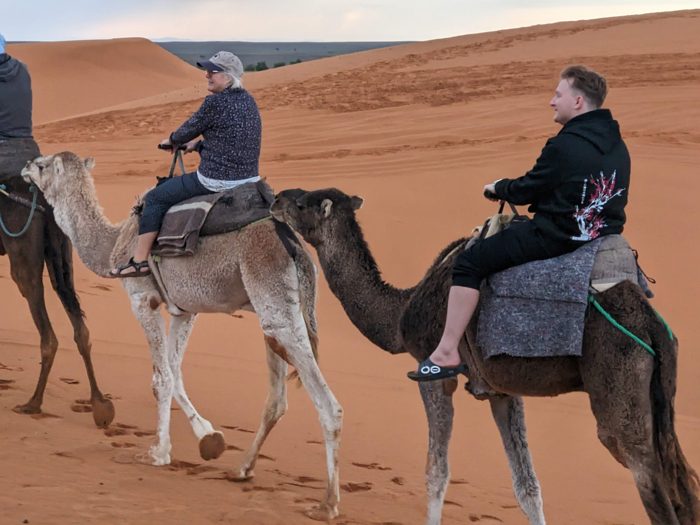
My 80-year-old mother, three kids, and I all climbed aboard our camels.
This alone felt like an achievement.
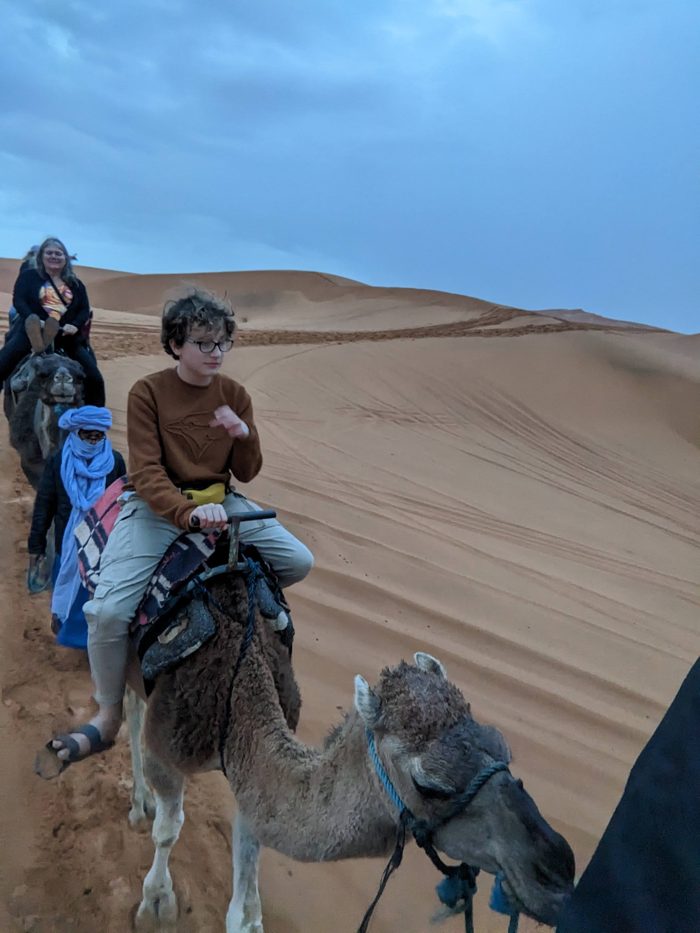
The camels were tied together in lines and led into the dunes. The Sahara stretched ahead of us in rolling waves of sand, golden and massive and somehow both empty and full at the same time.
It was beautiful.
Not postcard beautiful.
Bigger than that.
The kind of beautiful that makes everyone quieter.
The Sunset Did Not Attend Its Own Event
The plan was to ride camels into the dunes at sunset.
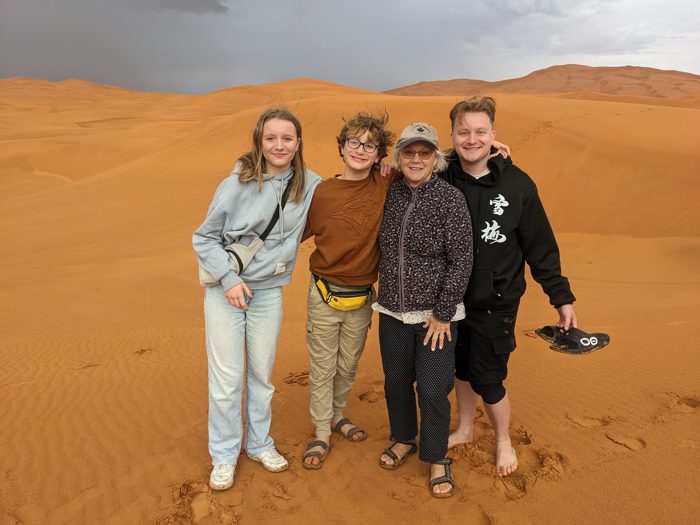
The Sahara, however, had other ideas.
Instead of a glowing orange sky and dramatic sun dropping behind perfect sand ridges, we got clouds. Then mist. Then a little rain.
Rain.
In the Sahara.
This felt like booking a tropical beach vacation and being handed a snow shovel.
Of course, the lack of sunset was disappointing, but the desert did not become less beautiful. It just became stranger. The clouds softened the light. The dunes turned muted and mysterious. The mist made the whole place feel dreamlike, as though the Sahara had decided to show us its moody artistic side.
The rain also made the sand firmer, which turned out to be helpful when walking.
After about half an hour on the camels, we stopped and climbed up to the crest of a dune for photos.
Walking up a sand dune is not walking.
It is negotiating with the earth.
Every step slides backward slightly. Your legs work harder than expected. Your lungs start asking why you did not train for this. The ridge line was easier, and once we reached the top, the views opened in every direction.
Sand.
Sky.
More sand.
More sky.
Zakary was in heaven.
He ran up and down the dunes with a level of energy that felt personally insulting after our long drive. I watched him sprint through the sand and wondered where children store this emergency desert power. Adults do not have this. Adults climb one dune and begin composing farewell letters to their knees.
Zak treated the Sahara like the world’s largest playground.
Which, to be fair, it is.
The Camel Ride Back and the Missing Bonfire
After a long break in the dunes, we mounted the camels again and began the ride back to the hotel.
By now, the light was fading. The dunes had taken on that soft evening color that makes everything feel calmer, even when your hips are reminding you that camel saddles were not designed by chiropractors.
The ride back was peaceful.
The camels moved slowly, rocking us from side to side. The guides led us quietly through the sand. The desert had a rhythm to it, and for a while, nobody needed to say much.
We were supposed to have a desert bonfire that evening, but the rain ruined that plan.
I am not sure what I expected from the Sahara, but “bonfire cancelled due to rain” was not on my list.
Still, it was hard to be disappointed. We had ridden camels through the Sahara. My mother had done it at 80 years old. The kids had climbed dunes. We had taken photos under cloudy desert skies. And Morocco had once again refused to follow the brochure version of itself.
Honestly, I respected that.
How to Exhaust a Child in One Easy Desert
Back at the hotel, Zakary crashed.
I do not mean he got a little sleepy. I mean the Sahara reached into his supply of energy and finally found the off switch.
Before dinner, he fell into such a deep nap that waking him up became a project. I had to work hard to bring him back to consciousness. For a moment, I thought he might faceplant directly into his dinner plate.
He managed to eat quickly, though, because even the deeply exhausted can find strength when food appears.
Then he was ready for bed by 7 p.m.
This may be one of the great parenting discoveries of the trip: to tire out a child, take him to the natural sandbox of the Sahara Desert and let him run.
No trampoline park can compete.
No playground can match it.
Just sand, dunes, and one child determined to conquer them all before dinner.
The Sahara Did Not Need to Be Perfect
That night, I thought about how the day had not gone exactly as imagined.
The drive was long.
The sunset disappeared behind clouds.
The desert bonfire was cancelled.
It rained in a place famous for dryness.
And yet, none of that made the day worse in the way you might expect.
Sometimes imperfect travel is better because it becomes more specific. Anyone can say they saw the Sahara at sunset. We could say we rode camels into the Sahara while it misted with rain, watched Zakary run wild across damp dunes, and returned to the hotel with everyone slightly sandy, slightly sore, and completely satisfied.
That feels more like us anyway.
Family travel rarely hands you the perfect postcard. It hands you the wrong weather, a tired child, a camel with opinions, and a memory that somehow becomes better because it did not behave.
Morocco had taken us from the medieval maze of Fes to the open silence of the Sahara in a single long day.
And even without the sunset, the desert stayed with me.
In the next installment, we wake before sunrise, climb the dunes on foot, film our own tiny version of Dune, and then bounce through the desert in a 4×4 like someone accidentally combined cultural travel with a roller coaster.