
November 15, 2024 • Norm
Day 2 — The Road to Fes Started With Romans, Couscous, and Children Being Volunteered for Things
There is something wonderfully dangerous about waking up on the second day of a trip and believing you have adjusted.
You have not.
Your body still thinks it belongs in another time zone. Your suitcase has already become disorganized. Someone is missing a sock. Someone else is hungry even though breakfast ended 14 minutes ago. And yet, there you are, standing beside a vehicle in Morocco, ready to drive north toward Fes as though you are a fully functioning adult with a plan.
After our first night in Casablanca — which involved trains, tiny taxis, a closed mosque, and an inDrive driver who treated police officers like natural predators — we were ready to move deeper into Morocco.
Our destination was Fes, one of Morocco’s great ancient cities. But first, we had a few stops to make.
Because apparently, when you travel with me, a three-hour drive is rarely allowed to remain only a three-hour drive.
The Romans Were Here Too, Apparently
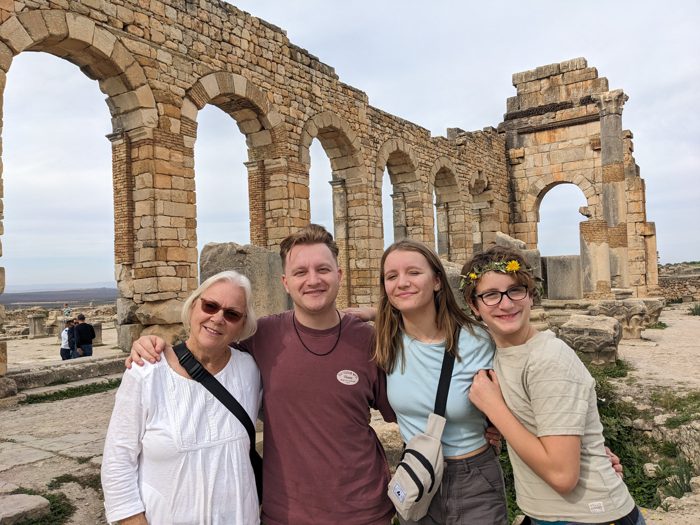
Our first major stop was Volubilis, a UNESCO archaeological site filled with ancient Roman ruins.
Now, I knew the Romans had been ambitious. They had a habit of showing up in places, building roads, installing columns, and generally behaving like they owned the known world. But there is still something surprising about standing in northern Morocco, looking at Roman ruins, and thinking, “Of course. You people made it here too.”
Volubilis had the remains of old streets, stone columns, floor mosaics, and pieces of buildings that had somehow survived centuries of weather, empires, and tourists taking photos at slightly awkward angles.
We walked along the old main road, where large stones still covered ancient drainage channels. There were remnants of olive presses, which made the whole place feel less like a museum and more like a city that had simply gone quiet. People had lived here, worked here, eaten here, complained about taxes here, and probably told their children not to climb on important things here.
This last point felt relatable.
The kids wandered through the ruins with varying levels of interest. Ancient history is impressive, but if you are a child, the true appeal of ruins is that they look climbable. As a parent, you spend half your time saying things like, “Careful,” and the other half trying to decide whether the thing they are standing on is priceless or just old.
Sometimes in archaeology, the line feels unclear.
The mosaics were especially impressive. Even with pieces missing, they still had detail and color, tiny stones arranged into images from a world that felt both impossibly far away and surprisingly familiar. There is something humbling about realizing that people thousands of years ago were also decorating their homes, making food, building neighborhoods, and trying to leave something behind.
The Romans did a fairly good job of that.
My travel planning, by comparison, had already failed at airport transportation on Day 1.
Lunch With a Purpose
After Volubilis, we stopped at a women and child cooperative for lunch.
This was one of those experiences that quietly stays with you. It was not flashy. There were no grand entrances or dramatic viewpoints. Just a meal, served with care, that supported single women and their healthcare needs.
We sat down to a traditional Moroccan spread with lentils, blended cauliflower, chickpeas, eggplant, olives, and then chicken with warm spices. It was simple, filling, and flavorful in a way that made you slow down.
Travel has a way of making food more memorable. Maybe it is because you are hungry. Maybe it is because everything is new. Or maybe it is because the best meals are not just about what is on the plate, but about where you are sitting and why the meal matters.
This lunch mattered.
It was also the beginning of my realization that Morocco was going to feed us very well and very often.
This is both a blessing and a danger.
A blessing because Moroccan food is wonderful.
A danger because after several days, your pants may begin filing formal complaints.
Arrival in Fes, Followed by the Sacred Travel Nap
We arrived in Fes in the early evening.
At this point, we needed one of the most important travel rituals known to families: the emergency power nap.
Not a full sleep. That would be dangerous. A full sleep can destroy an evening and leave everyone wide awake at 2 a.m., staring at the ceiling and questioning geography.
No, what we needed was a controlled 30-minute reset.
The kind where you lie down fully clothed, promise yourself you will not fall into a coma, and then wake up confused about what country you are in.
After the nap, our guide took us on a short orientation walk around the hotel. We saw the long central plaza running through the city, a wide open space that reminded me a bit of the Champs-Élysées in France, though with a very Moroccan personality of its own.
We also stopped for cash.
This became another practical lesson: in Morocco, cash is important. I am used to tapping a card for nearly everything, but many restaurants, shops, and smaller places were cash-based. ATMs became less of a convenience and more of a survival strategy.
There are moments as a traveler when you realize the person with cash is the person with power.
Also snacks.
Usually snacks.
Dinner and the Moment My Children Became Entertainment
That evening, we booked an optional excursion to a traditional Moroccan dinner show.
It cost about 300 MAD per person, and by this point we were ready for music, food, and something that did not involve negotiating with taxi drivers.
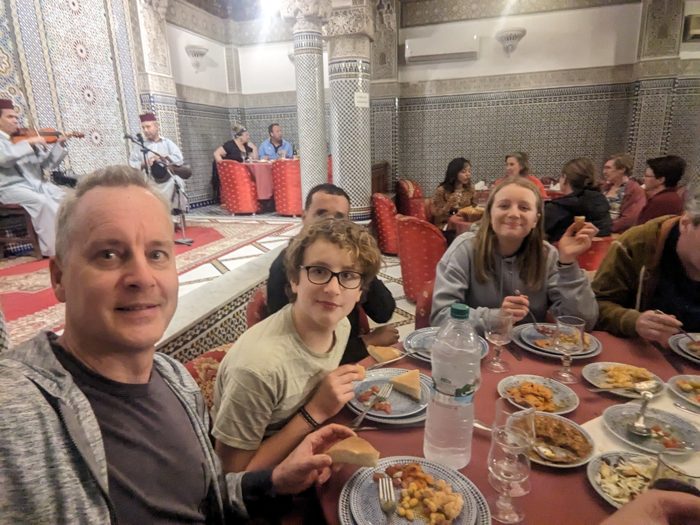
When we arrived, we were seated directly in front of the stage. This is usually exciting until you remember that front-row seats often come with front-row risk.
Live traditional music filled the room, and dinner began with another generous spread of Moroccan dishes. There was lamb, beef, couscous with vegetables and raisins, and all the familiar flavors that brought me back to my younger years living in France, where Moroccan couscous meals had made a strong impression on me.
Food has a funny way of connecting different chapters of your life. One minute you are in Fes with your children and mother, and the next you are remembering meals from decades earlier in France.
Then the performers reminded us we were very much in the present.
There was traditional music, dancing, and a Moroccan fire dance. Orin was selected to go up on stage with a female dancer to try it out, which was fun to watch in the way only a parent can enjoy watching their child be publicly recruited into something unexpected.
Then came the “surprise.”
Four people from the audience were selected.
This included my children.
Of course it did.
There is an invisible force in travel that identifies children whose father is trying to quietly observe and immediately sends them to the stage.
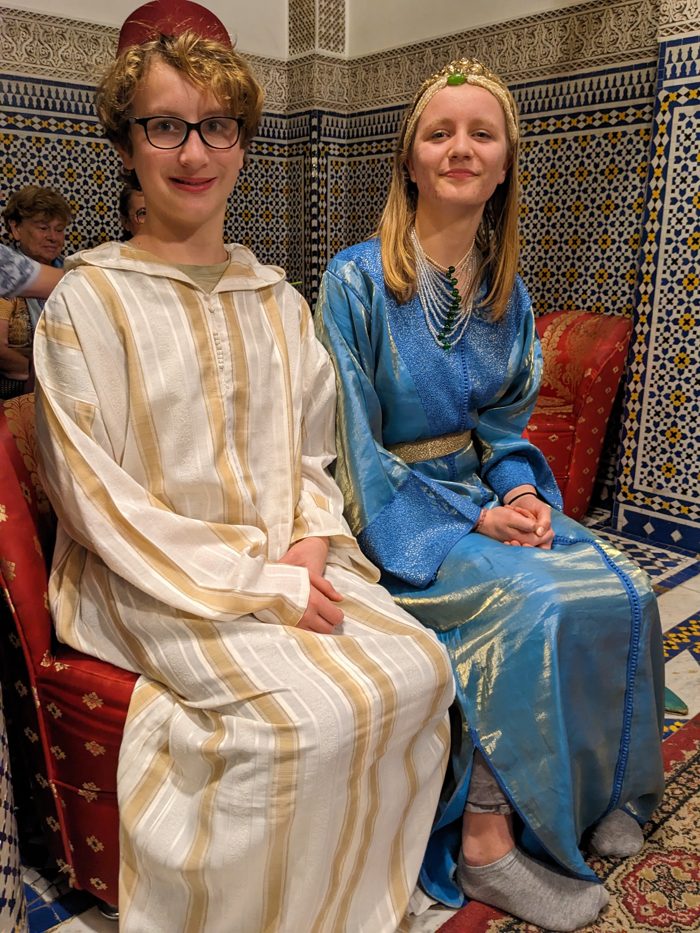
Teyauna, Zakary, and another teenager from France were dressed in traditional clothing. Zak ended up in a fancy robe and a red Fez hat, looking surprisingly official for someone who had probably been sleepy ten minutes earlier.
Teyauna was placed in a basket and lifted onto the shoulders of three women while music played. I believe it was part of a wedding tradition, though as a father watching his daughter being hoisted into the air in a basket in Morocco, my historical analysis was temporarily limited.
Mostly I was thinking, “Well, this is new.”
And also, “I hope everyone involved has good balance.”
The kids handled it beautifully. They laughed, played along, and became part of the evening in a way that no planned family photo could ever capture.
That is one of the best things about travel. You can plan the route, book the hotels, arrange the transportation, and schedule the tours. But the moments everyone remembers are often the ones where somebody points at your family and says, “You. Come here.”
Fes Was Already Working on Us
By the time the evening ended, we were ready for sleep.
The day had carried us from Casablanca to Roman ruins, from a cooperative lunch to the streets of Fes, and finally into a room full of music, food, and children dressed in traditional Moroccan clothing.
It was only our second day, but Morocco was already doing what good travel does. It was stretching us a little. Feeding us a lot. Making us laugh. Giving us history without making it feel trapped behind glass.
And most importantly, it was giving us stories.
The kind you cannot create by following a schedule perfectly.
The kind that happen when your children are pulled on stage and you realize the best thing you can do is keep your camera ready.
In the next installment, we step into the ancient medina of Fes, a place with more than 9,000 winding streets, strong smells, beautiful tiles, and the very real possibility of being permanently separated from your group if you stop too long to look at spices.