
April 21, 2026 • Norm
Day 3 — Peace, Palaces, Orange Juice, and Marie Antoinette’s Village
Tuesday, April 21, 2026
By our third day in France, the time zone fog was starting to lift. Nobody slept much past 8:00 a.m., which felt like progress. We were still not exactly morning people, but we were beginning to resemble humans who knew what continent they were on.
Our appointment at the Palace of Versailles was not until 2:30 p.m., so we had a slower morning. We took the metro and then a train out to Versailles, only to discover one of those classic travel lessons: arriving in the city of Versailles is not the same thing as arriving at the Palace of Versailles.
This is the kind of distinction that seems obvious after you learn it.
After reaching Versailles, we got on a bus — unfortunately going the wrong direction. A few stops later, GPS revealed that we were not moving toward the château at all. We were exploring Versailles, just not the part we intended to explore. Travel has a way of humbling anyone who thinks they have “figured it out.”
A Quiet Stop: The Paris Temple
We corrected course and made our way first to the Paris France Temple of The Church of Jesus Christ of Latter-day Saints.
The temple visit was peaceful and quiet, especially compared with what was coming later at Versailles. The building was beautiful and fit naturally into the surrounding architecture, even though it was modern and had only been built in recent years. Its design was simple, lower than the Palace of Versailles, and respectful of the area. Some of the windows were patterned after windows at Versailles, which gave it a subtle connection to the place.
We visited the small visitors’ center, took the kids inside, and got a photo by the Christus statue. It was a calm and meaningful way to spend the morning — almost no crowds, no rushing, no one telling us we were on the wrong bus. Just peace.
Versailles in All Its Gold
From there, we took a short Uber ride, about five minutes, to the Palace of Versailles. By the time we arrived, roughly 15 minutes before our 2:30 entrance time, the crowds were already huge. Lines of people stretched around the entrance, and the quiet of the temple quickly gave way to the grand, busy spectacle of one of the most famous palaces in the world.
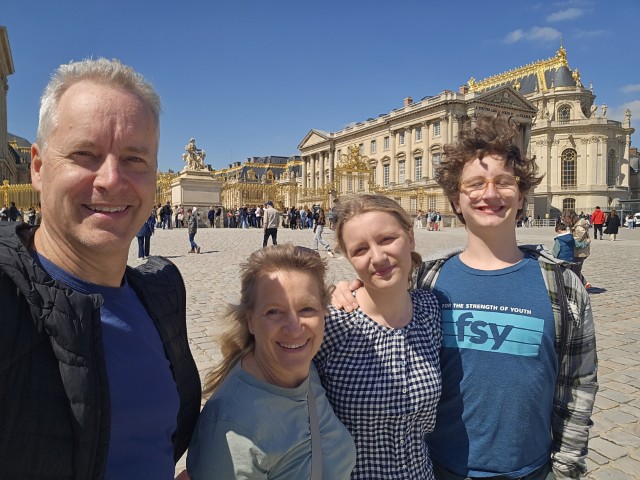
Versailles does not whisper. Versailles announces itself.
Inside, we each used the Rick Steves audio tour on our phones and headsets. That made the palace much more meaningful because we were not just wandering through rooms looking at chandeliers and gold trim. The audio guided us from room to room and explained the history of the paintings, statues, decorations, royal apartments, and the people who had lived there.
We saw the famous Hall of Mirrors, Napoleon’s room, and the rooms connected to Louis XIV, Louis XV, Louis XVI, and the long, complicated history of French royalty. The palace was enormous, ornate, and impressive in a way that almost becomes overwhelming. Every wall, ceiling, and doorway seemed to be making an announcement: “Yes, we had a budget, and no, we did not believe in blank space.”
There was gold. There were paintings. There were ceilings that seemed to have more drama than most movies. It was magnificent, but also so grand that it made you understand how ordinary people might eventually have looked at all of it and thought, “Perhaps this is a bit much.”
After touring the palace, we made our way out into the gardens. The grounds seemed to stretch forever. From certain viewpoints, the property just kept going and going into the distance. The gardens were beautiful, though it was disappointing that many of the large musical fountains were not running while we were there. Even without the fountains, the scale was incredible. It was hard not to wonder how many gardeners and landscapers it takes now — and how much harder it must have been hundreds of years ago before lawnmowers and modern equipment.
Marie Antoinette’s Hamlet and the Best Orange Juice
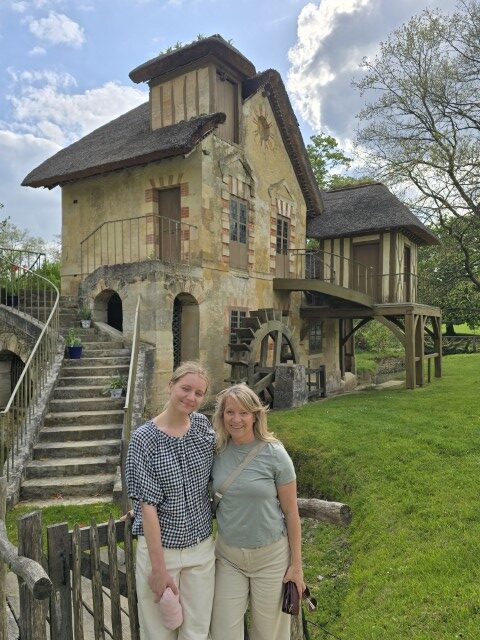
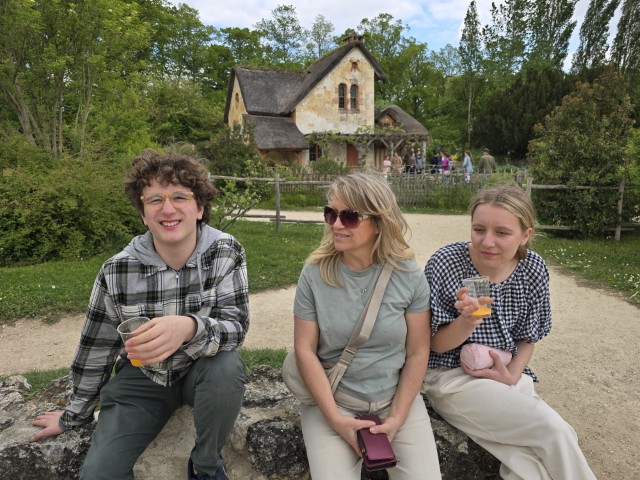
One of the favorite parts of the day was visiting Marie Antoinette’s hamlet, the little village and cottages created on the estate. This area felt completely different from the palace. Instead of glittering rooms and polished mirrors, it had a quieter, more rustic feeling. The kids liked learning that it had been set up like a real village, with real people and real activity connected to it.
It also gave us a more human view of Marie Antoinette and Louis XVI. Instead of seeing them only as distant historical figures, the stories helped us understand that they were complicated people, and that much of what people believed about them was shaped by misunderstanding, politics, and public anger.
Near the hamlet, we stopped at a small café and had salads, fresh quiche, and freshly squeezed orange juice. The orange juice became one of those simple travel memories that sticks. It was squeezed right in front of us, and it connected back to the history of Versailles, where citrus trees had once been kept in greenhouses and brought out into the sun when the weather was warm enough.
After the crowds, palace rooms, endless gardens, royal history, and walking paths, that glass of orange juice tasted especially good. Sometimes the grandest places are remembered through the smallest details: a quiet temple, a wrong-way bus, a child noticing how far the gardens go, and fresh orange juice after wandering through the world of kings and queens.