
May 15, 2026 • Norm
Day 27 — Police Checkpoints, Stack-Parked Cars, Ruined Ruins, and Skopje’s Statue Explosion
Friday, May 15, 2026
Route: Peja, Kosovo → Patriarchate of Peć → Prizren → Skopje, North Macedonia
Peja gave us one last surprise before we left Kosovo.
The Patriarchate of Peć
We started the day at the Patriarchate of Peć, just down the road from where we were staying. It sounded simple: visit a peaceful old monastery, then drive to Prizren and continue to Skopje.
Simple, of course, is not always how the Balkans choose to participate.
The road to the monastery was blocked by police guards. They told us it was open, but we had to show ID. I handed over my driver’s license, and then we waited while one of the officers seemed to call someone on his cell phone.
Daniel looked at me.
“Do you think they are checking if Canada is real?”
“Maybe they’re calling my mother.”
“Would she approve the visit?”
“Probably. But she’d ask if we had eaten.”
Eventually, they let us through.
The monastery itself was peaceful and beautiful. The Patriarchate of Peć is one of the most important Serbian Orthodox religious sites in Kosovo, with medieval churches, old frescoes, quiet grounds, and nuns still living there. After the guards and the ID check, the atmosphere inside felt even more still. It was the kind of quiet that makes you lower your voice without anyone asking.
A nun told us we could not take photos inside, which was fine. Sometimes not photographing a place forces you to actually look. We walked through slowly, taking in the old stone, the church interiors, the layers of history, and the calm of the grounds.
Daniel summed it up best.
“It’s peaceful,” he said. “There’s a serene spirit here.”
He was right.
A Ruined Ruin at Prizren
Then we drove to Prizren.
We had almost skipped Prizren, but it kept showing up as a must-see. And when a place repeatedly says “must-see,” eventually you either go or feel judged by the guidebook.
Parking in Prizren became its own cultural experience. We found a tiny central lot connected to a small hotel, with maybe enough room for six cars, except the cars were stacked in rows behind each other like automotive lasagna. An older gentleman was managing everything. We parked behind other cars and left him the key because there was no way anyone was escaping unless he rearranged the entire puzzle.
“This feels normal,” I said.
“No,” Daniel said. “This feels Balkan.”
Fair.
We walked through the town and up to Prizren Fortress. The fortress is free to enter, which is nice, though it also looked like it could use a few euros. In places, the wooden planks were questionable enough that I stepped carefully, partly to admire history and partly to avoid becoming part of it.
It was not just a ruin.
It was a ruined ruin.
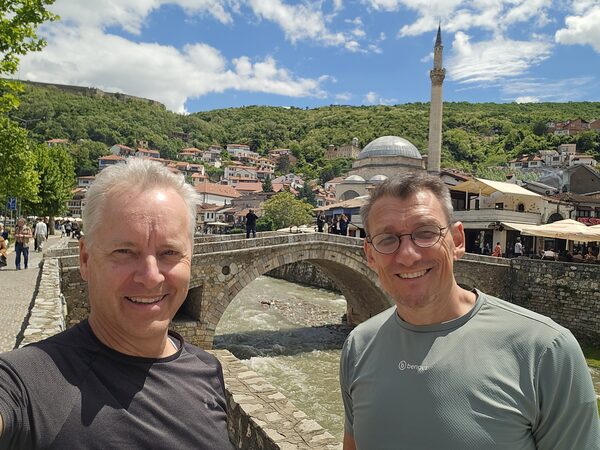
But the view was excellent: Prizren below, red roofs, mosque minarets, church towers, mountains, and the river threading through town.
Back near Sinan Pasha Mosque, it was prayer time. Men gathered outside to wash before entering, cleaning hands, arms, faces, and feet. We sat nearby with ice cream and watched respectfully.
“Cultural observation,” Daniel said.
“With dessert,” I added.
That may be the perfect travel formula.
Afterward, Daniel had to back the car out of the stacked parking lot. It was a tight escape, but he managed it without scratches, shouting, or creating an international parking incident.
From Prizren we drove toward Skopje. The border was uneventful, but the highway before it was unexpectedly impressive. On the Kosovo side, the road crossed huge bridges through a canyon area, lifted high above the valley. I kept looking at the engineering and wondering how long it must have taken to build.
At least this road was impressive in a way that did not make me grip the door handle.
Skopje and Its Statue Explosion
We arrived in Skopje in the evening. Our vacation rental was tricky to find, and the people on site did not speak English. The rental contact lived in the United States, so we ended up calling America on WhatsApp to check into an apartment in North Macedonia.
Modern travel is strange: medieval fortresses in the morning, international tech support by evening.
Once settled, we walked toward the Old Bazaar and Macedonia Square. The bazaar was interesting, with narrow lanes and Ottoman atmosphere, though by evening many shops were quiet. Then we crossed the river, and Skopje changed personality completely.
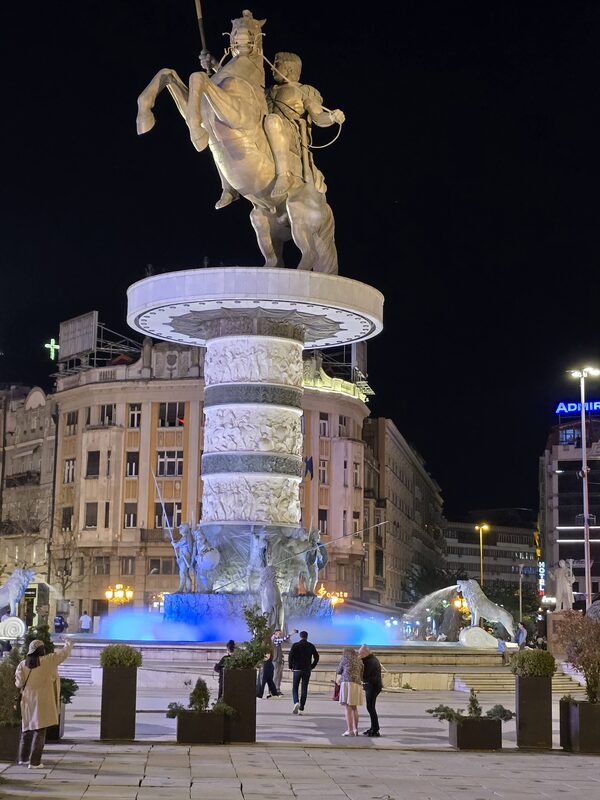
Macedonia Square was enormous, lit up, and packed with statues, fountains, bridges, columns, bronze heroes, horses, lions, and dramatic lighting.
Daniel stopped.
“I did not expect this.”
Neither did I.
Skopje does not whisper history. It puts it on a horse, adds fountains, turns on the lights, and throws in mist effects.
The huge fountain associated with Alexander the Great was especially memorable, with water dropping, spraying, shooting upward, and glowing under the lights. Nearby were statues connected with Philip II, Olympias, and other figures. Every bridge seemed to have its own decorative ambition.
“Skopje does not believe in empty space,” I said.
“Or small statues,” Daniel replied.
Dinner was near the fountain of Olympias holding baby Alexander. The restaurant had some kind of Canada connection in the wording, so as a Canadian, I felt morally obligated to eat there.
That was the end of the day: police at a monastery, peaceful nuns, Prizren’s fortress, mosque prayer preparations, ice cream research, stacked parking, high canyon bridges, WhatsApp check-in gymnastics, and Skopje’s nighttime statue explosion.
Some cities whisper.
Skopje arrives with a fountain show.