
November 16, 2024 • Norm
Day 3 — Fes Tried to Lose Us in 9,000 Streets and Then Handed Us Mint
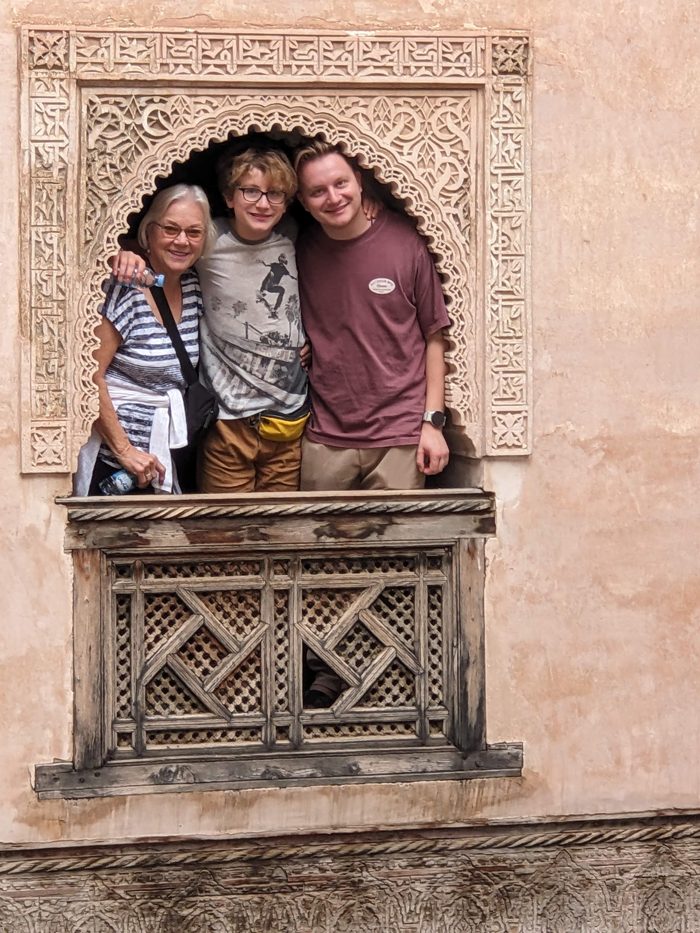
There is a special kind of confidence you feel before entering a medieval medina with more than 9,000 winding streets.
It is completely undeserved.
You look at your guide, your family, and the narrow entrance ahead and think, “Sure, this will be fine.” Then you step inside and immediately realize that if you were left alone, your children would one day find you living above a spice shop, selling scarves and pretending this had been your plan all along.
Welcome to Fes.
This was our first full day in Morocco without a long road trip, which sounded relaxing. No packing the bags. No early drive. No hours in a vehicle watching the landscape shift outside the window.
Instead, we would spend the day walking through one of the oldest and most fascinating cities in Morocco.
Walking, of course, is a word that can mean many things.
In Fes, it means entering a living maze and hoping your guide has no enemies.
The Palace Gates Were Showing Off
We began the morning at one of the old royal palace gates.
The palace itself was not open for us to wander through, which is reasonable. I also do not allow random tour groups to walk through my house, though admittedly my front door has less tilework and fewer centuries of royal significance.
The gates were stunning.
They were covered in intricate tile designs and framed by ornate carved wood that looked like it had required the patience of several generations. The colors, patterns, and symmetry were almost hypnotic. Moroccan architecture has a way of making blank walls feel lazy.
Everything seemed detailed. Every surface had purpose. Even the doors looked like they were wearing formal clothing.
We stood there taking photos, admiring the craftsmanship, and trying not to look too much like people who had already taken 47 versions of the same picture.
This is one of my weaknesses when traveling. I see something beautiful and think, “I should take one photo.” Then the light changes slightly, someone moves two inches to the left, and suddenly my phone contains enough palace gate images to produce a documentary.
The Tile Factory and the Art of Not Leaving Quickly
Our next stop was a tile and pottery factory.
At first, it was fascinating. Artisans shaped clay into bowls, plates, and decorative pieces. Others painted delicate patterns by hand. We watched workers cut tiny tiles into specific shapes for tables, fountains, and mosaics.
The skill involved was incredible.
Each piece required patience, precision, and the kind of hand control I do not possess. I struggle to put a screen protector on a phone without creating an air bubble shaped like South America.
The artisans made it look effortless.
Of course, the tour eventually led to the showroom.
This is a universal travel law. Any demonstration involving handmade goods will eventually end in a room where everything is beautiful, breakable, and available for purchase.
Negotiation is an important part of Moroccan culture, and a few members of our group got deep into the process. This can take time. A lot of time. Negotiating in Morocco is not a quick “yes” or “no.” It is more like theater with numbers.
There is the first price.
Then the shocked face.
Then the counteroffer.
Then the disappointed face.
Then walking away.
Then being called back.
Then tea may become involved.
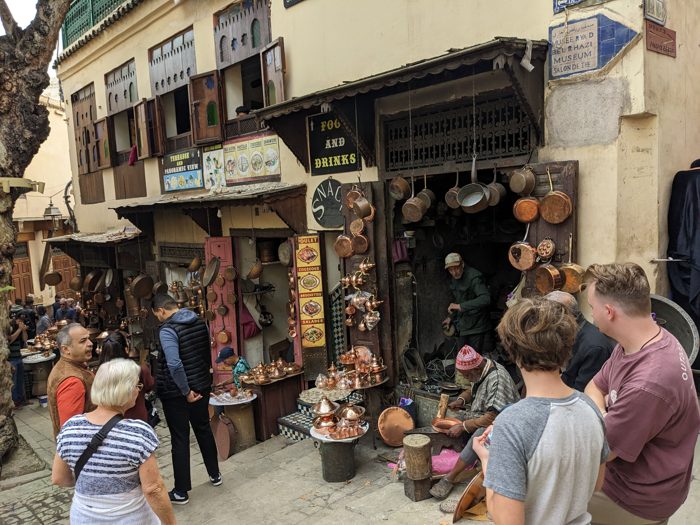
Meanwhile, the rest of us stood around trying to look interested in large ceramic fountains we had no practical way to take home.
I admire the culture of bargaining, but I am not naturally gifted at it. My instinct is to either pay too much immediately or feel so awkward that I accidentally apologize to the seller for not buying a table.
Eventually, we escaped with our group intact.
This would become an important theme for the day.
The Medina Does Not Care About Your Sense of Direction
After a viewpoint overlooking the old city, we entered the medina of Fes.
The Fes medina dates back to the 9th century and is often described as the largest living medieval medina in the world. It covers a huge area and contains more than 9,000 streets and alleyways.
Calling them streets feels generous.
Many were narrow corridors, twisting between homes, shops, workshops, and doorways that seemed to lead into other centuries. Some were wide enough for small groups. Others made you instinctively turn sideways even if nobody was coming.
The medina was not a museum. It was alive.
Carpenters worked in small shops. Bakers pulled bread from ovens. Butchers displayed their goods. Fish sellers called out. Spice vendors arranged colorful piles in careful cones. There were live chickens, camel meat, shark meat, olives, fabrics, lamps, leather goods, and enough visual information to overwhelm every part of the brain.
It was crowded, loud, beautiful, and confusing.
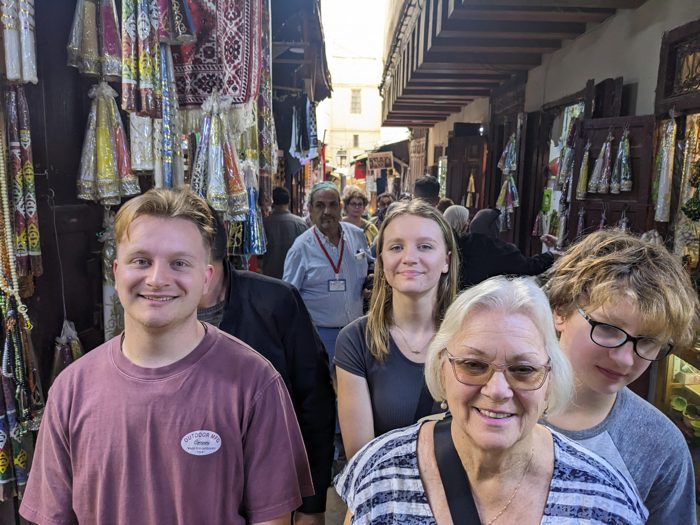
And we had one job: stay with the group.
This sounds simple until one person stops for a photo, another slows down to look at spices, and someone else is distracted by a cat. In a place like Fes, falling behind is not a minor inconvenience. It is the beginning of a possible new life.
The alleys turned and split constantly. Every doorway seemed to hide another courtyard. Every shop looked like it had been packed by someone who believed empty space was a personal failure.
There were moments when I could only see the person directly in front of me. I kept counting children in my head.
One.
Two.
Three.
Mother.
Good.
Repeat.
Travel with family often turns you into a shepherd with a camera.
Courtyards, Lunch, and the Beauty Hidden Inside
One of the fascinating things about old Moroccan cities is how much beauty is hidden on the inside.
From the narrow alleys, many buildings look plain or closed off. But then you step through a doorway and suddenly find a courtyard filled with tilework, carved plaster, columns, and calm.
We visited an old university courtyard that reflected this perfectly. The open interior space felt peaceful compared with the energy outside. It was a reminder that in places like Fes, the best views are not always from the street. Sometimes the city keeps its beauty tucked away, waiting behind wooden doors.
Lunch was another traditional Moroccan meal, which by this point was becoming both expected and dangerous.
Moroccan food is generous. It does not arrive timidly. It arrives with plates, bowls, sauces, bread, and the quiet assumption that you did not really mean it when you said you were full.
We ate, rested, and prepared for more exploring.
I was already beginning to understand that Fes was not a place you simply visit. It is a place that absorbs you. The sounds, the smells, the tight passageways, the sudden courtyards, the shopkeepers, the donkeys, the history underfoot — it all builds into something you feel more than organize.
That said, I still preferred having a guide.
There is confidence, and then there is foolishness.
The Tannery Smelled Like History With Poor Ventilation
The highlight of the medina visit was the ancient tannery.
Before entering the viewpoint area, we were handed mint leaves.
This was not decorative.
This was survival equipment.
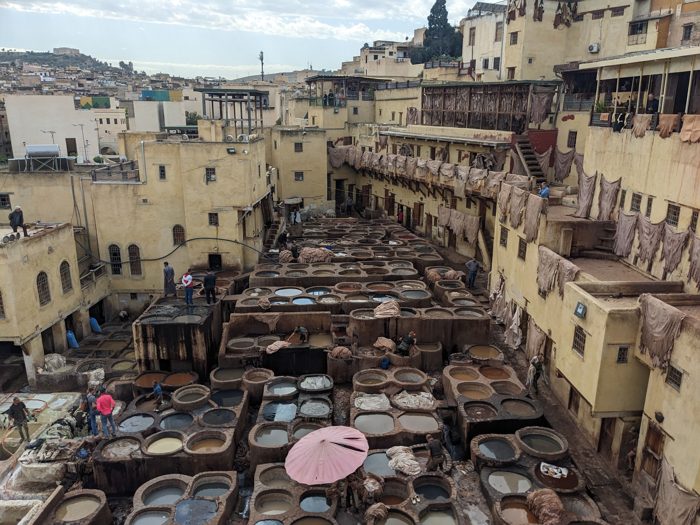
From a third-story terrace, we looked down over dozens of round vats filled with different colors. Workers moved hides through the tanning process, first treating camel and cow leather in white limestone water mixed with pigeon droppings, then transferring them into dye vats.
It was fascinating.
It was colorful.
It was ancient.
It smelled like every bad decision ever made by an animal product.
The mint was essential. You crushed it and held it near your nose, trying to convince your brain that you were in a refreshing garden instead of standing above centuries of leather production.
The tannery was impressive because it was still being used in a traditional way. This was not a recreated display. This was work. Hard work. Smelly work. Skilled work. The kind of work that makes you look at a leather bag very differently.
Of course, the viewpoint was inside a large leather shop.
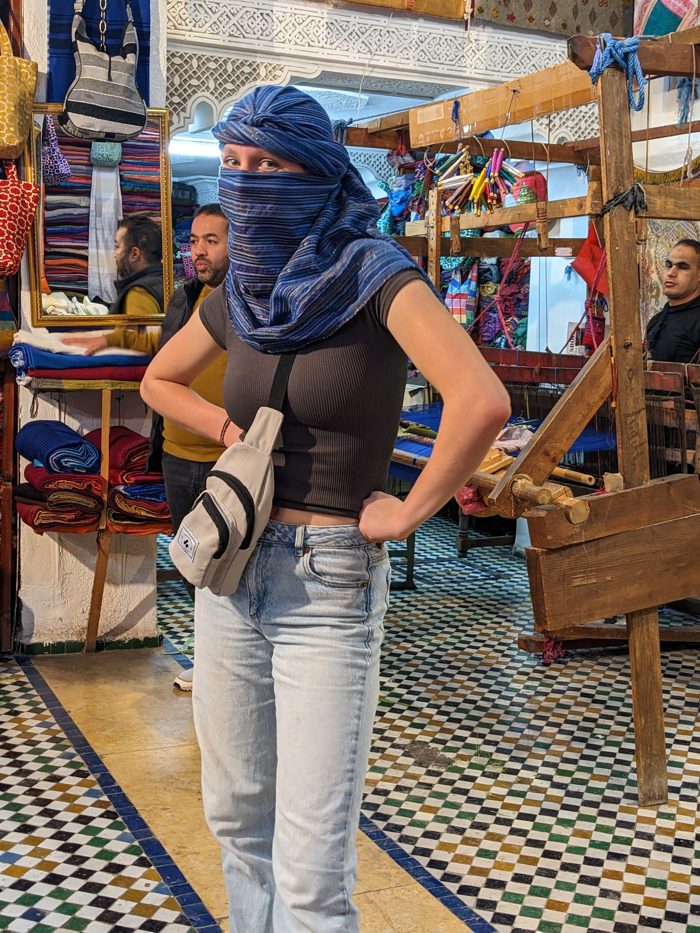
This made sense. First, they show you how leather is made. Then they show you everything leather can become. Bags, coats, poufs, slippers, wallets — if it could be made from leather, it was probably somewhere in that building.
I admired many things.
I bought fewer things.
This is called restraint, and I like to practice it occasionally so my suitcase does not explode.
Fes Was a Beautiful Overload
By the end of the day, we were tired in the way only a full walking day can make you tired.
It is different from road-trip tired. Road-trip tired makes you stiff. Medina tired makes your feet question your leadership.
But what a day.
Fes had given us palace gates, tile workshops, ancient courtyards, crowded markets, hidden beauty, strong smells, and a maze that made Google Maps seem like a children’s toy.
It was one of the most fascinating places I had ever walked through.
Not because it was perfectly preserved behind ropes, but because it was still alive. People lived there. Worked there. Shopped there. Argued over prices there. Baked bread there. Carried goods through alleys there.
The medina was not performing history.
It was continuing it.
And we had been lucky enough to walk through for a day, following our guide like ducklings through a medieval labyrinth, clutching mint leaves and trying not to lose a child among 9,000 streets.
In the next installment, we leave Fes behind for a long drive through the Atlas Mountains toward the Sahara Desert, where the camels are waiting, the dunes are massive, and Zakary discovers that the world’s largest sandbox is a very effective way to exhaust a child.