
May 1, 2026 • Norm
Day 13 — A Labor Day Taxi Miracle, Český Krumlov, Wood-Fired Meat, and One More Country on the List
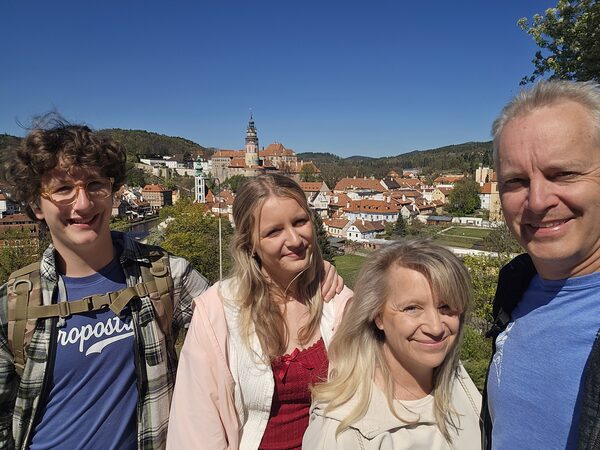
Friday, May 1, 2026
On Friday, May 1, 2026, we were docked in Linz, Austria. But instead of spending the day in Linz, Normand had another idea. The cruise ship had an optional tour to Český Krumlov in the Czech Republic, but a few days earlier we had found FlixBus tickets that were about a quarter of the price.
That was all the encouragement Normand needed.
A Spontaneous Plan to Cross Into Czechia
There was also one more important factor: he wanted to add another country to his list. A short hop into Czechia sounded much more interesting than staying in Linz, and Český Krumlov was not just any little town. It was a UNESCO World Heritage Site, a preserved medieval town tucked into a bend of the Vltava River, with a castle above it and enough storybook charm to make a person start speaking in phrases like “quaint little lanes,” even if they normally never say things like that.
So the plan was simple: take an Uber to the bus station, ride about an hour and a half to Český Krumlov, wander the town, and return later that day.
Travel plans are always simple before reality gets involved.
The Labor Day Taxi Miracle
What we did not fully realize was that May 1 was Labor Day, a national holiday. We came out expecting to order an Uber and be on our way. Instead, we waited five to ten minutes while no Uber accepted our ride. The minutes began to feel shorter and more dramatic. Somewhere in the back of Normand’s mind, a countdown clock began ticking toward our bus departure time.
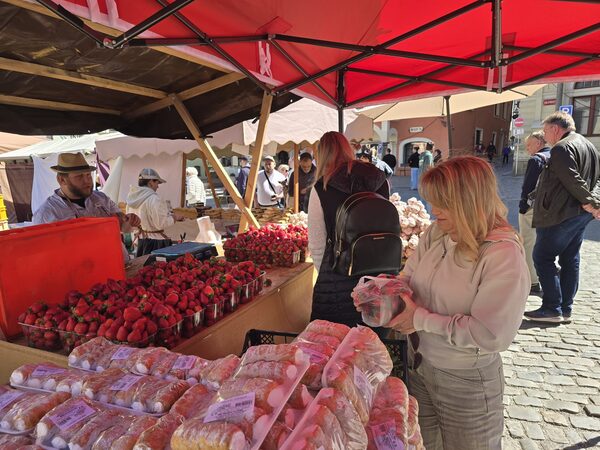
After no car appeared, Normand asked a guide from one of the other groups where to go. The guide directed us a couple of blocks toward the main square, where we might be able to find a taxi. That sounded hopeful.
It was not immediately hopeful.
We reached the square and still could not find one. Now the stress level increased from “mild inconvenience” to “we may have just bought discount bus tickets to watch our bus leave without us.” Normand asked a police officer where we could find a taxi, and the officer told us to wait in the square.
Just at that moment — in what felt like a tiny travel miracle — a taxi pulled up beside the police car.
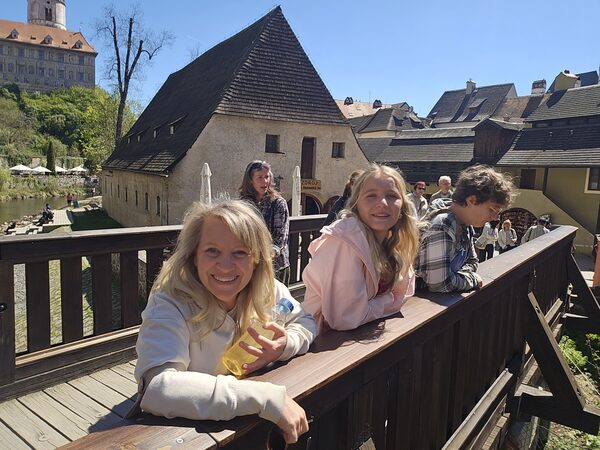
We arranged the ride, climbed in, and made it to the bus station with about two minutes to spare before the bus left. Two minutes. That is not early. That is not comfortable. That is not “we planned well.” That is “everyone breathe later.”
But we made it.
The bus ride to Český Krumlov took about an hour and a half. As we crossed from Austria into Czechia, Normand could officially add another country to the list. It was a small deviation from the cruise itinerary, but that was part of the fun. Sometimes the best travel moments come from stepping slightly sideways from the expected route.
Wandering Český Krumlov
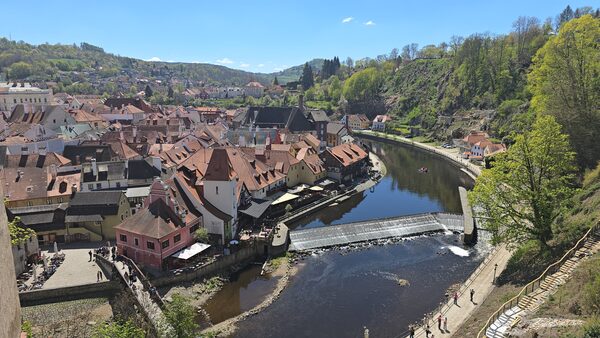
The bus dropped us at the station, and we walked about 10 to 15 minutes toward the old town. Before we even entered the medieval center, we passed a beautiful viewpoint overlooking the town. From there, Český Krumlov looked like something arranged for a painting: red rooftops, a castle tower, church spires, stone buildings, and the Vltava River wrapping around the town in a graceful curve.
The historic center of Český Krumlov grew inside a meander of the Vltava River, which gives the town its dramatic shape. The castle rises on a rocky promontory above the river, and the old town spreads below it in a maze of lanes, courtyards, and centuries-old buildings. The town developed from the Middle Ages and still shows Gothic, Renaissance, and Baroque layers in its architecture. It is not hard to see why UNESCO recognized it. The whole place feels remarkably intact, as though the modern world arrived politely and agreed not to disturb too much.
We walked into the village and began wandering through the old streets. The buildings were stone and plaster, with painted facades, red-tiled roofs, and little details that made every corner worth looking at. The town sits partly on the side of the hill, so you are always moving up, down, around, and through. It feels like the streets were designed by people who had never heard of straight lines and had no interest in them.
We made our way up toward the castle and through its courtyards. The Český Krumlov Castle complex is enormous compared with the size of the town below, and it dominates the skyline. It began in the 13th century and was shaped over time by powerful noble families, including the Rožmberks, who helped transform it into a Renaissance showpiece. Walking through the courtyards gave us that layered European feeling again: stone underfoot, painted walls around us, views over the rooftops, and the sense that hundreds of years had passed through the same gates before us.
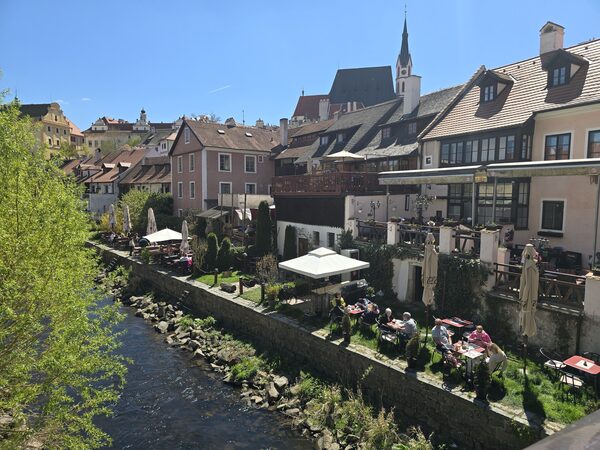
From the castle areas, the views back over the town were beautiful. The river curved around the old center like a ribbon. The rooftops clustered tightly together. The church tower and castle tower seemed to rise from the same story. It was easy to understand why so many people make the trip there.
After about three to four hours of wandering, though, we had seen what we wanted to see. Český Krumlov is beautiful, but it is also small. There are shops, restaurants, museums, rafting opportunities, and tours, but if you are mostly wandering, you can reach the point where the town has been thoroughly admired and your feet begin voting for a bench.
So we sat on a bench and relaxed.
This may not sound exciting, but after the number of steps we had accumulated across Europe, sitting on a bench in a medieval Czech town felt like a legitimate attraction.
Wood-Fired Meat and the Ride Back
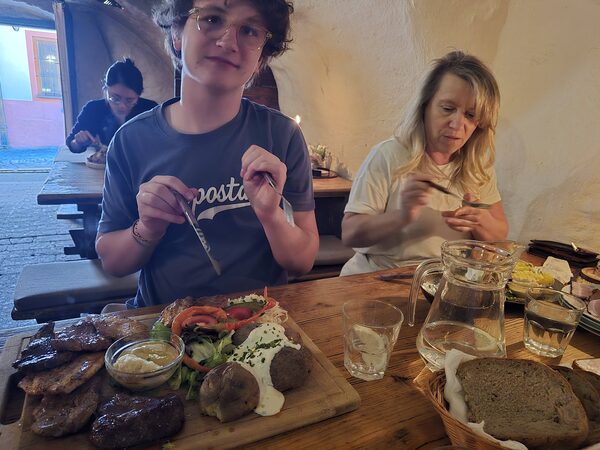
We also had a delicious lunch at a tiny restaurant with a wood-fired grill. We sat near the man cooking over the fire, which made the whole meal feel rustic and immediate. There is something about watching food cook over actual flames that makes you suddenly trust your lunch more.
Normand and Zakary ordered a multi-meat platter with different kinds of meat. It was delicious. It was also far too much food for two people. We could probably have shared it with everyone and still had enough left over to feed a small castle guard. This has become one of the themes of family travel: you think you understand portion sizes, and then another country humbles you.
By the end of the day, we caught our bus back, though it was about 15 minutes late. We arrived back in Linz and took a train from the main train station to the main square, where we could easily walk back to the cruise ship.
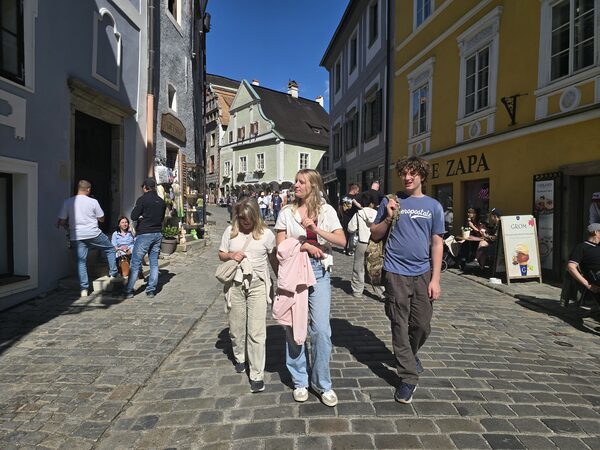
It had been a beautiful, relaxing day, though we all agreed on one practical point: seven hours in Český Krumlov may be a little long unless you really like shopping, plan to do a museum or castle tour, book an extra activity, or want to spend time on the river. There was an escape room that looked especially fun, with people dressed up and taking guests in one at a time. That would have been a great way to add another hour. Canoeing or rafting on the Vltava would also be an option, though the river looked slow and peaceful, and we decided not to do it.
Still, the day was worth it. We crossed into another country, explored a UNESCO medieval town, walked through castle courtyards, ate far too much wood-fired meat, and enjoyed a slower day outside the standard cruise itinerary.
Linz may have been our official port, but Český Krumlov became the story of the day: a near-missed bus, a taxi that appeared at exactly the right moment, a river-wrapped town of red rooftops and old stone, and one more country added to Normand’s list.